
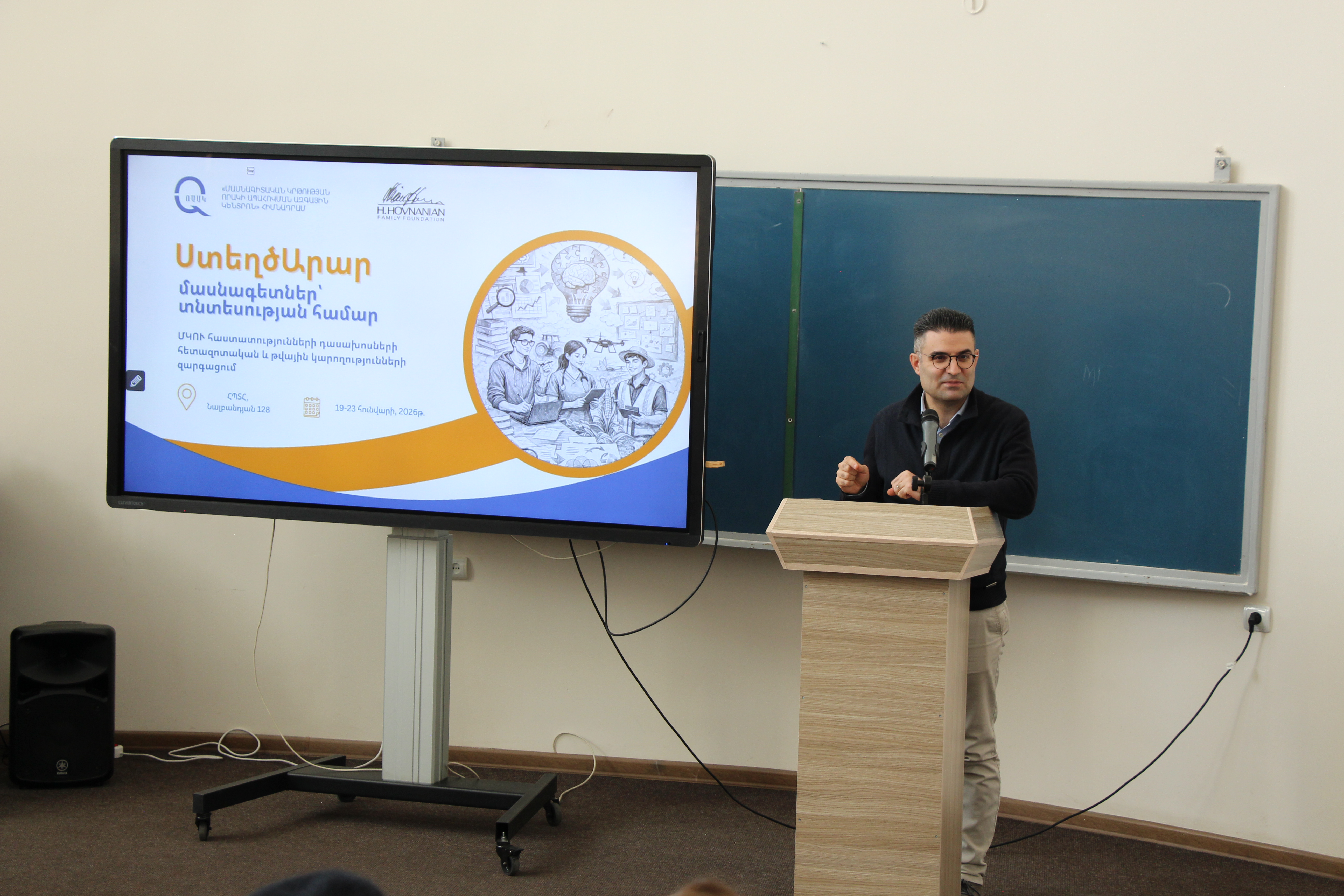
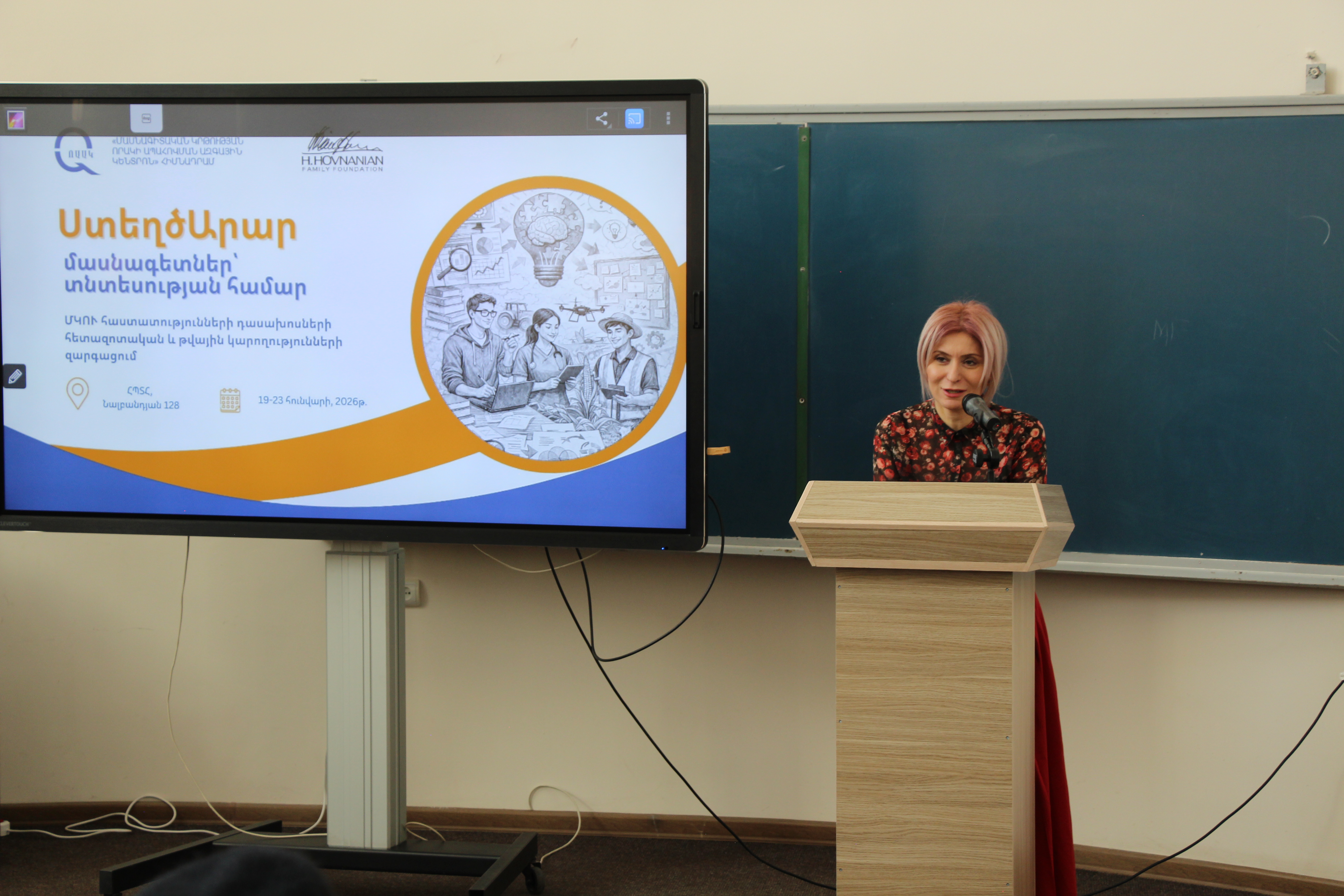
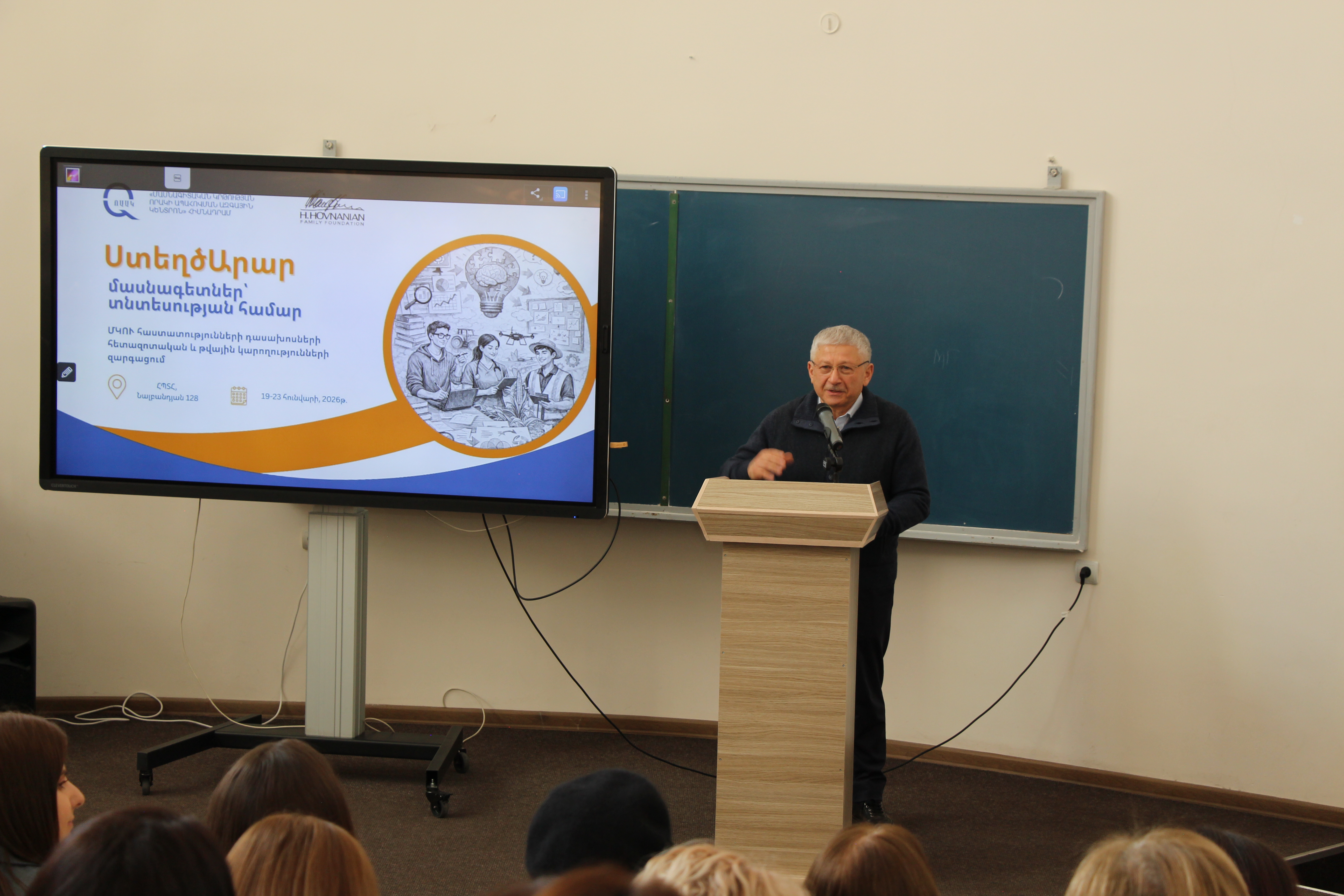
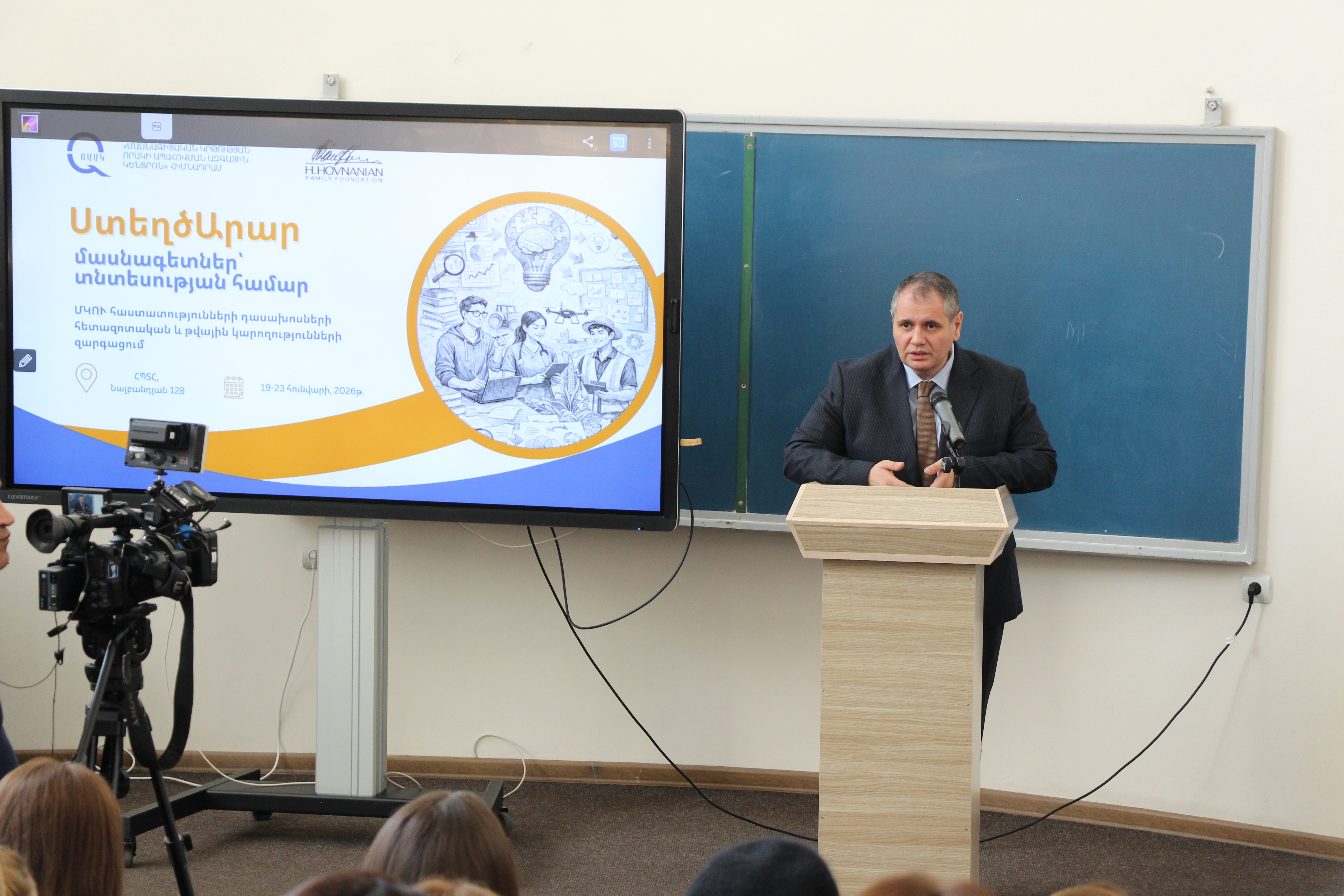
On January 21, the Armenian State University of Economics hosted the official launch of the training “Building Innovative Teaching Capacities in VET (Development of Research and Digital Skills)” under the motto “Creative Specialists for the Economy”.
The aim is to strengthen teaching capacity in the VET system, empowering teachers to prepare not only skilled practitioners, but also proactive research-oriented specialists, capable of adapting to a rapidly evolving labour market. The kick-off event brought together 80 teachers, industry leaders, and representatives of partner organisations.
Armen Grigoryan, rector of the Armenian State University of Economics (ASUE), delivered the opening speech, highlighting ANQA’s key role in the ASUE’s development. “ANQA’s contribution to the development of ASUE is undeniable. More than ten years ago, we were among the first to start this cooperation, and today our institution is qualitatively different. Our management staff also completed ANQA’s training programme, and the experience gained from three accreditations has provided us with invaluable guidance. I am confident that this training will be equally transformative for you”, the rector noted, wishing the participants productive activities and the successful transfer of the acquired skills to students.
Ruben Topchyan, ANQA’s acting director, addressed the need for changes in educational approaches, highlighting that modern students require the ability to apply and adapt knowledge, rather than simply rely on mechanical accumulation. “Our goal is to create a mechanism that transforms basic knowledge into a tool for acquiring new, locally relevant labour-market skills. Today, 80 specialists are gathered here to become pioneers of change”, mentioned Dr. Topchyan adding that an online meeting with the participants is scheduled in a month to share success stories and classroom achievements. “Success comes from working together. Good luck to each of us”, concluded Ruben Topchyan.
Araksia Svajyan, deputy minister of the RA ESCS Ministry, attached importance to the collaboration between different education bodies and the private sector, considering it a prerequisite for significant quality enhancement. Ms. Svajyan pointed out that the VET sector has seen considerable growth in recent years, as evidenced by over 16,000 students admitted to VET institutions this year. “However, the increase in numbers is still not a guarantee of quality. The cornerstone of qualitative change is the training and attestation of teachers,” the deputy minister noted, adding that with more than 4,000 specialists in the VET sector, the involvement of 80 participants is notable and signals the beginning of a chain of change. According to Ms. Svajyan, each teacher, upon returning to their institution and applying new approaches, makes an irreplaceable contribution to the process of systemic reform.
Korioun Khatchadourian, executive director of the H. Hovnanian Family Foundation, thanked ANQA's team, stressing that the project goes beyond training. “We will measure our impact not by today's meeting, but the changes in the labour market in three-five years, noted Mr. Khatchadourian, highlighting the teachers’ key role in that chain. According to Korioun Khatchadourian, the Foundation provided the resources, ANQA offered the expert knowledge, but the true project implementers are the teachers, who bring the innovative ideas to the students and, ultimately, the labour market.
The need for the project arises from accreditation results and labor market analyses, indicating that theoretical knowledge alone is insufficient. A modern VET teacher should be skilled in research tools and be able to review and modernise academic programmes based on real-world issues, data and analysis. This approach ensures that students graduate not with pre-set methods, but with the capacity to analyse professional challenges, draw evidence-based decisions and propose practical solutions.
The trainings is conducted in three interconnected stages.
The first stage fosters a research-oriented environment and introduces digital tools implemented as effective methods for teaching and research. The second stage presents the full research process, from the formulation of a professional question to data collection and analysis, drawing on the modules they deliver. The third stage is dedicated to the incorporation of research findings into academic programmes, making courses more practical, problem-based and aligned with the requirements of the labour market.
Trainings are organised in sectoral groups. Sessions for teachers in the agrarian sector are set to take place on January 19-21, led by Andreas Melikyan, Doctor of Agricultural Sciences, Professor. IT sector teachers are scheduled to take part in the sessions on January 20-22, under the leadership of Ruben Topchyan, Candidate of Physical and Mathematical Sciences, Associate Professor. The medical sector training is scheduled for January 21-23, led by Ishkhan Sokhakyan, Candidate of Medical Sciences, doctor.
It should be noted that the main stage of the project was preceded by pilot trainings held in September for representatives from medical, IT and agricultural VET institutions. During that period, the training materials were piloted to further improve and clarify the project.
By the end of the project, approximately 80 VET teachers are expected to have modernised academic programmes and course descriptors, geared towards the preparation of specialists with creative, research-oriented thinking and practical skills for the economy.
ANQA expresses its gratitude to the H. Hovnanian Family Foundation and all the experts for their contribution to the development of research-oriented and proactive VET specialists.