
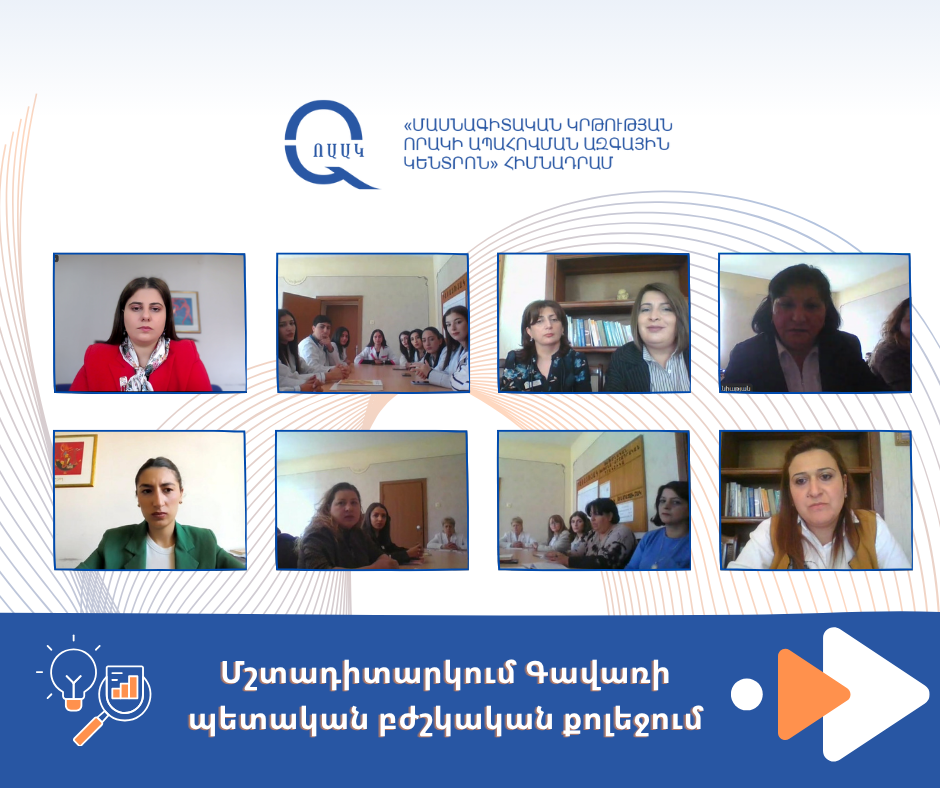
On October 23, ANQA conducted a monitoring of the internal quality assurance system at the Gavar State Medical College. The goal was to observe the education institution’s quality assurance processes, the post-accreditation changes, as well as the current issues and challenges.
It should be noted that the Gavar State Medical College received four-year institutional accreditation in 2024.
As part of the online monitoring, meetings were held with the education institution’s director, deputy directors, heads of chairs, teachers, students and the quality assurance manager.
The meetings focused on the following topics:
- Enhancement and evaluation of academic programmes (APs)
The discussion addressed post-accreditation changes made to the APs, their goals and effectiveness. Reference was made to the review of outcome and assessment methods, the practice of formative assessment, as well as the impact of changes on student progress. - Development of the quality assurance system
The implementation of the annual quality assurance plan, the setting of priorities, the mechanisms for data collection and analysis, as well as decision-making support tools were observed. - Research activities
The discussion focused on whether the institution has well-defined research directions, the extent of research activities, and the involvement of both students and teachers. The availability of research guidelines and assessment templates was observed. - Development of the teaching staff
The observations covered the steps taken for the training and professional development of teachers, as well as the processes of identifying and addressing needs. - Student progress and employment
The discussions focused on the student progress amid ongoing changes, the alumni’s employment rates and the mechanisms implemented by the institution to track their careers. - Practical training and internships
Reference was made to internship formats, their scope and effectiveness, to evaluate how well students apply and strengthen institution-acquired practical skills in employer settings. - Resources
The discussion addressed whether the institution has sufficient material, technical, and human resources to effectively implement the APs and achieve the intended outcomes, and how resources are planned and replenished. - Enhancement of foreign language proficiency and professional communication skills
The discussion highlighted the importance of foreign language proficiency and professional vocabulary for fostering interdisciplinary cooperation, keeping up with field developments and engaging in international programmes. - KPIs and data use
The discussion covered the specific indicators and data that guided the institution in the implementation of post-accreditation changes, and their role in supporting informed decision-making.
At the end of the monitoring, a meeting was held with the institution’s management staff to underscore current achievements and identify key enhancement areas. In particular:
- The presence of KPIs and the approach based on them were emphasized, with importance placed on their inclusion in short-term development plans.
- The continuous studies and data analysis for the AP enhancement, as well as the involvement of chairs in this process, were underscored.
- The need to improve assessment criteria for the ensurance of clear and measurable indicators for each outcome was stressed.
- The practice of joint use of employers' resources was highlighted, underlining the need to expand cooperation and ensure its sustainability.
- It was emphasised that the research should focus on targeted professional development and be connected to the students’ professions.