
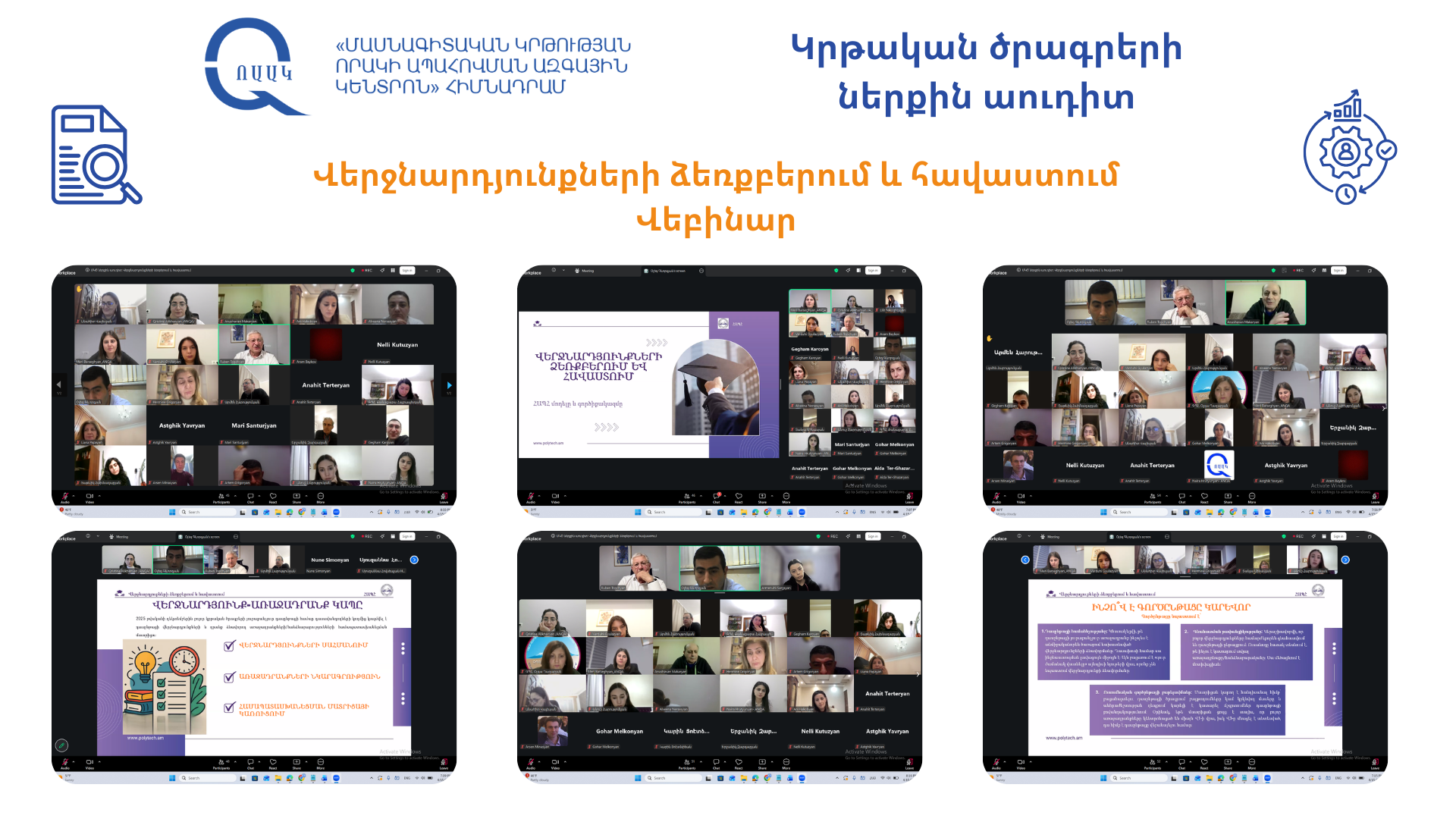
On April 15, ANQA held an online webinar “Self-Audit of Academic Programmes: Achievement and Verification of Outcomes”. The webinar aimed to present the formats and tools applied by HEIs to ensure and verify the achievement of learning outcomes of academic programmes (APs).
During the webinar, the National Polytechnic University of Armenia shared its practice, highlighting the alignment between learning outcomes and assignments as a key element of the process. This alignment is established through a matrix, which enables teachers to systematically link learning outcomes to assignments based on course syllabi, ensuring consistency. This approach supports not only the organisation of the learning process but also self-evaluation and the identification of potential gaps.
It was noted that the matrix also serves as an important self-audit tool, enabling data-driven AP analysi. It contributes to the coherence of course content, assessment transparency and increased student motivation, while also allowing for adjustments to APs.
The institution applies a multi-level assessment system that includes interim and final assessments, ensuring a comprehensive evaluation of the learning outcomes achieved throughout the learning process. Meanwhile, it was noted that efforts to further improve the assessment system are ongoing.
Particular emphasis was placed on the role of the graduation works as a key component in the achievement and verification of learning outcomes.
The format of joint graduation works was also presented, which is based on collaboration across different professional fields and supports comprehensive development of student competences.
The discussions highlighted that the use of matrices enables the systematic evaluation of course effectiveness, ensures a clear link between assignments and learning outcomes and facilitates the AP self-audit.
Ruben Topchyan emphasised that the formulation and assessment of learning outcomes should be assignment-based, since they serve as the primary means of the assessment of student knowledge and competences. According to Dr. Topchyan, an effective approach is to first clearly define the assignments and then formulate the learning outcomes accordingly.
Ruben Topchyan also mentioned that an informal collaborative environment has been established to develop common approaches for more effective AP implementation. In this regard, emphasis was placed on the adaptation of the presented practice to the specific context of HEIs and its application within their respective institutional systems.
It was highlighted that self-audit should be data-driven and conducted through clearly defined QA mechanisms. Particular emphasis was placed on data collection and analysis as a key prerequisite for effective self-audit.
The participants were encouraged to develop systems that enable systematic data collection, tracking of student progress and outcome achievement. It was emphasised that only on this basis can reliable assessment be conducted and evidence-based conclusions on the AP effectiveness.