
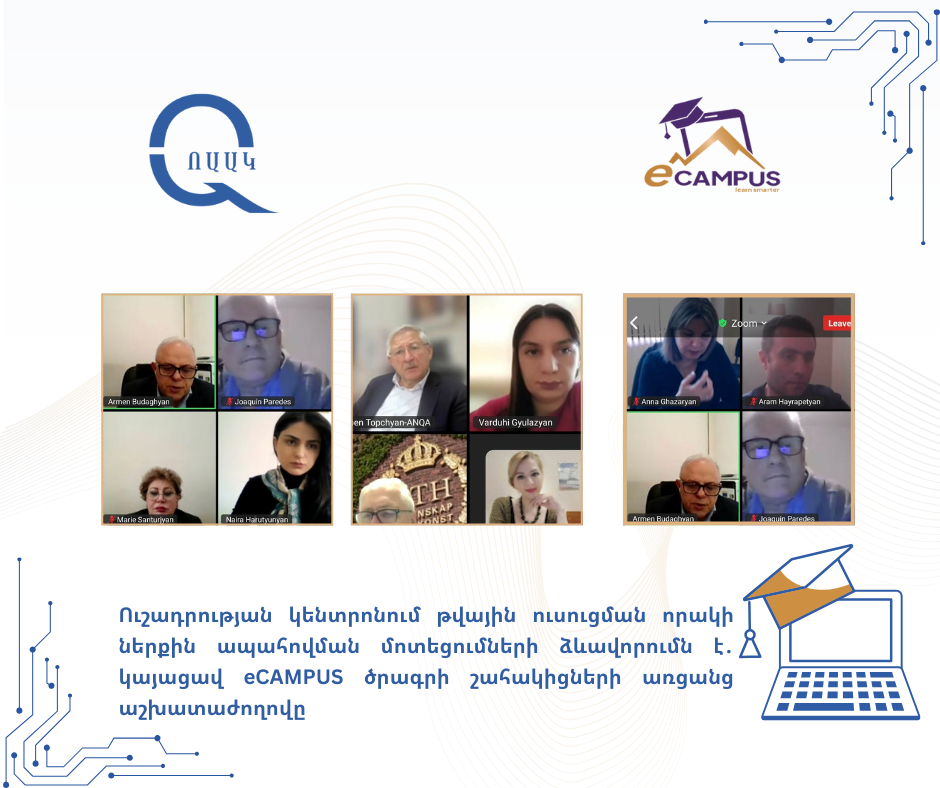
On December 16, the working group for Work Package 3 (WP3) of the Erasmus+ eCAMPUS project held an online workshop to present the progress of implemented activities and discuss next steps. ANQA is responsible for the WP3.
ANQA shared insights into the development of an internal quality assurance system for digital learning and teaching, outlining implemented activities, challenges encountered, and potential solutions.
The discussions focused on current approaches to the quality assurance of digital teaching at Armenian HEIs, management and strategic planning issues, as well as the need for systematic implementation of internal quality assurance mechanisms. It was highlighted that the development of digital teaching requires an institutional approach grounded in shared quality principles and a culture of continuous enhancement.
Reference was also made to the Quality Assurance Policy for Digital Learning and Teaching, which is under development. Its core principles and goals were introduced, including student-centredness, comparable quality across various teaching formats, academic integrity, accessibility and inclusion, as well as the ethical and responsible use of digital technologies.
The participants emphasised that the proposed approaches should support the HEIs' internal self-evaluation and development, without substituting external QA and accreditation mechanisms. It was also proposed to more explicitly highlight inclusion, accessibility and equal opportunities in the policy paper.
The workshop ended with the summary of further steps, targeting the refinement of the policy paper, the ongoing joint discussions with partners, and the development of internal QA tools for digital teaching.
"Fostering Socially Distanced and Inclusive on-Campus Education in Armenian HEIs" (eCAMPUS) project aims to enhance the quality of digital teaching and learning at Armenian HEIs through a number of strategic initiatives. These initiatives encompass the development of the teaching staff’s digital skills, the introduction of internal quality assurance mechanisms for digital teaching and learning, the formation of educational digital ecosystems with relevant infrastructure, the use of innovative educational methods, as well as the formation of a supportive legislative framework.