
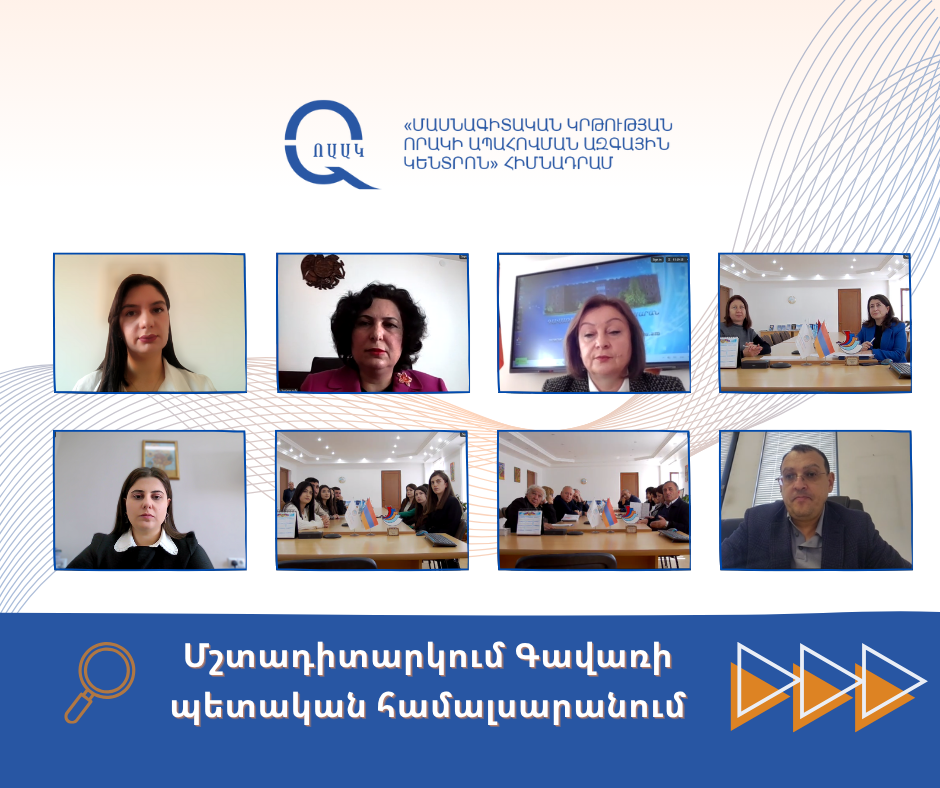
On October 15, ANQA conducted online monitoring at the Gavar State University.
The aim was to track the changes resulting from accreditation, observe the progress and outcomes of the follow-up plan, as well as the challenges faced by the education institution.
It should be noted that the Gavar State University was granted a four-year reaccreditation in August 2022.
As part of the monitoring, meetings were held with the education institution's rector and vice-rectors, heads of chairs, teachers, students and specialists from the Quality Assurance Department.
The focus was on the following issues:
- The process of enhancing and ensuring the effectiveness of the academic programmes (APs)
conduct of internal audits, result analysis, follow-up planning and the implementation of the PDCA cycle.
- The quality assurance system of academic programmes
mechanisms for identifying the need for changes, development of follow-up plans and quality assurance.
- The modernisation of academic programmes and their alignment with the labour market
approaches to the introduction of new subjects, monitoring of the labour market trends and ways to respond to them.
- The student-centered learning and development of professional competencies
development of professional thinking, acquisition of practical skills in the employer settings. - The ensurance and assessment of the triad knowledge, ability and skills
how the institution ensures that students or alumni achieved all intended outcomes and how each component is assessed.
- The enhancement of the assessment system
implemented methods, best practices in formative assessment and their connection to learning outcomes.
- The effectiveness of internships and research activities
with regard to students' research topics and master's theses.
- The role of assignments in the teaching process
examples of assignments that build analytical and research skills, and practical methods to reinforce theoretical knowledge.
- The use of AI in the educational process
in relation to teaching and assessment effectiveness and modern approaches.
- The level of foreign language proficiency and interdisciplinary collaboration
initiatives to promote professional foreign language proficiency.
- The evaluation of the institution’s KPIs
implementation of the KPIs, evaluation of student satisfaction data, ensurance of alumni employability and career tracking.
At the end of the monitoring, the key outcomes and enhancement areas were summarised with the institution's management staff.
An importance was attached to the integration of the AI practice into the educational process and the introduction of a skills-based assessment system, enabling the evaluation of all intended outcomes.
The KPIs’ clarity and measurability were also highlighted as important.