



Credit distribution is an important indicator of the academic programme (AP) quality. It demonstrates the extent to which student workload, course content and learning outcomes are aligned. Therefore, benchmarking should go beyond the comparison of the number of credits allocated to the same or similar subjects and analyse the reasons behind these differences.
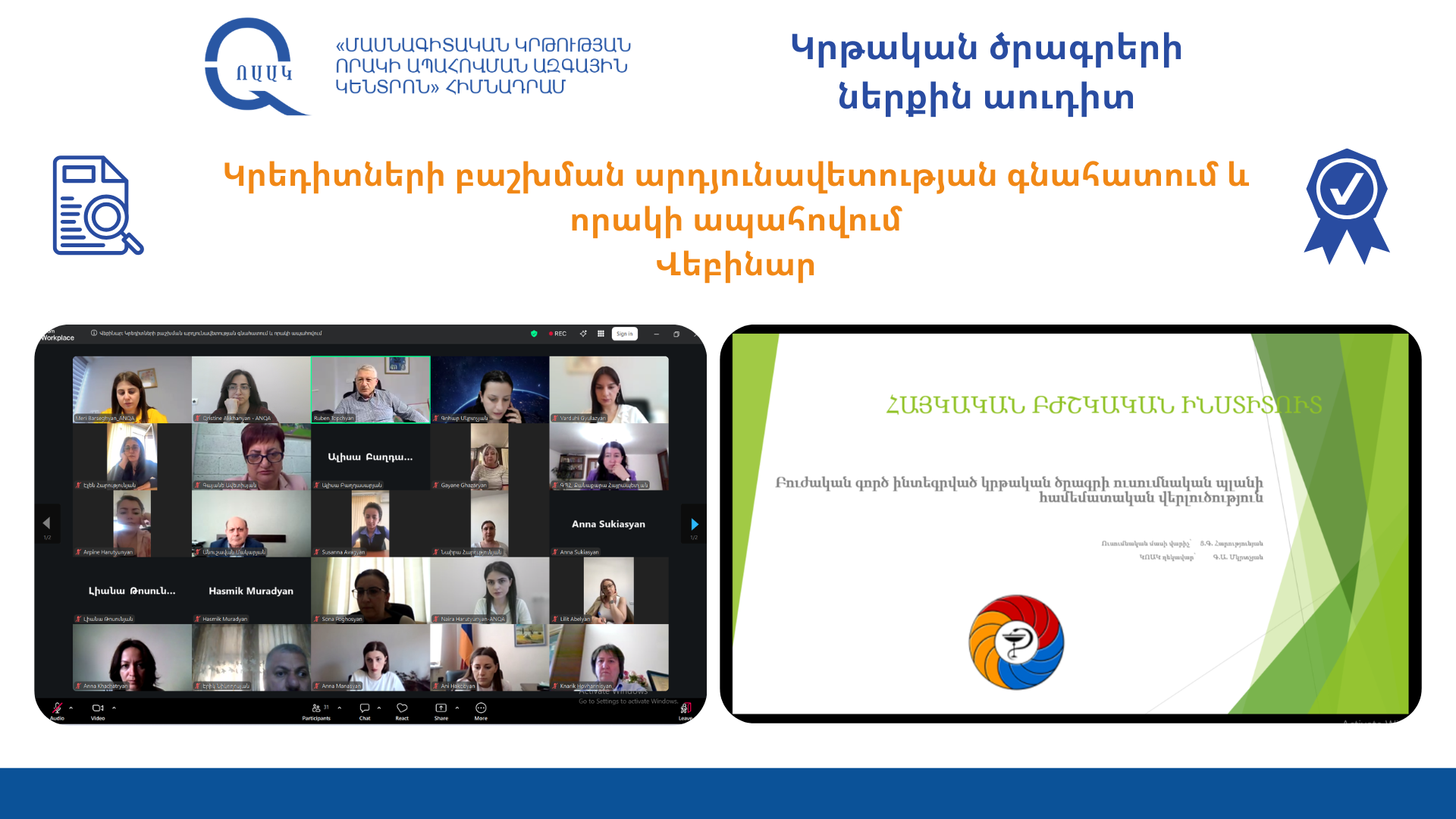
This approach was at the core of the webinar “Evaluation of the Effectiveness of Credit Distribution and Quality Assurance: Discussion of Best Practices” organised by ANQA on 4 June. Held as part of the “Self-Audit of Academic Programmes” project, the webinar aimed to facilitate the discussion and exchange of HEI practices.
The discussion highlighted that a credit cannot be regarded solely as a numerical indicator of the curriculum. It should capture the overall student workload, including classroom, practical and independent components, along with the learning outcomes to be achieved through the course.
Participants noted that differences in credit allocation for the same or similar subjects across HEIs may may affect the recognition of learning outcomes, continuity of education and academic mobility. Meanwhile, it was highlighted that the differences in credit distribution are not inherently problematic or beneficial. They should be analysed in relation to the subject content, the learning outcomes, the theoretical and practical components, the independent student workload and the AP structure.
Through this approach, benchmarking becomes a tool not only for comparison, but also for the evaluation of the AP quality. It helps determine whether the sequence of subjects is logical, the credit distribution is aligned with the intended learning outcomes, the amount of independent student workload is realistic and the AP structure supports the gradual development of student competencies.
The Armenian Medical Institute shared its practice in benchmarking the curriculum of the integrated AP "General Medicine".
The presented example demonstrated that benchmarking requires to study not only the subject title or the number of credits, but also the subject's place in the AP, its links to preceding and subsequent courses, the depth of its content, the practical component and the actual independent student workload.
The discussions highlighted that, as part of the self-audit, differences in credit distribution should be analysed not only quantitatively but also in relation to the volume and complexity of the student workload required for a given course. In some cases, the differences may be determined primarily by the amount of independent student workload, while the theoretical and practical components remain largely comparable. This means that the validity of credit distribution should be evaluated against the actual student workload.
During the webinar, special emphasis was placed on the evaluation of actual student workload. It was noted that HEIs use student surveys, discussions with teachers and estimates of the time required to complete individual assignments. Meanwhile, it was highlighted that methodological challenges and the lack of a unified approach to the evaluation of student workload still remain.
The issue of estimating the volume of independent student workload was also addressed. It was emphasised that the average time required for students to complete assignments should be considered alongside the course learning outcomes and the allocated credits. This makes it possible to evaluate whether the student workload is realistic and supports the achievement of the intended learning outcomes.
One of the key takeaways from the webinar was that HEIs need to develop clear mechanisms for evaluating the justification of credit distribution and tools applicable to the QA system. These tools should enable the regular evaluation of the extent to which the credits allocated to courses adequately reflect their content, complexity, intended learning outcomes, and actual student workload.
Student workload surveys, discussions with teachers and students, course mapping, benchmarking of thematic plans and learning outcomes, internal evaluations, class observations, benchmarking methodologies, and AP revision reports were identified as applicable tools.
Summing up the discussion, it was noted that the evaluation of the effectiveness of credit distribution should become an integral component of the AP self-audit. It supports the identification of discrepancies between learning outcomes, course content, and student workload, overlapping course content, and areas for programme enhancement.