

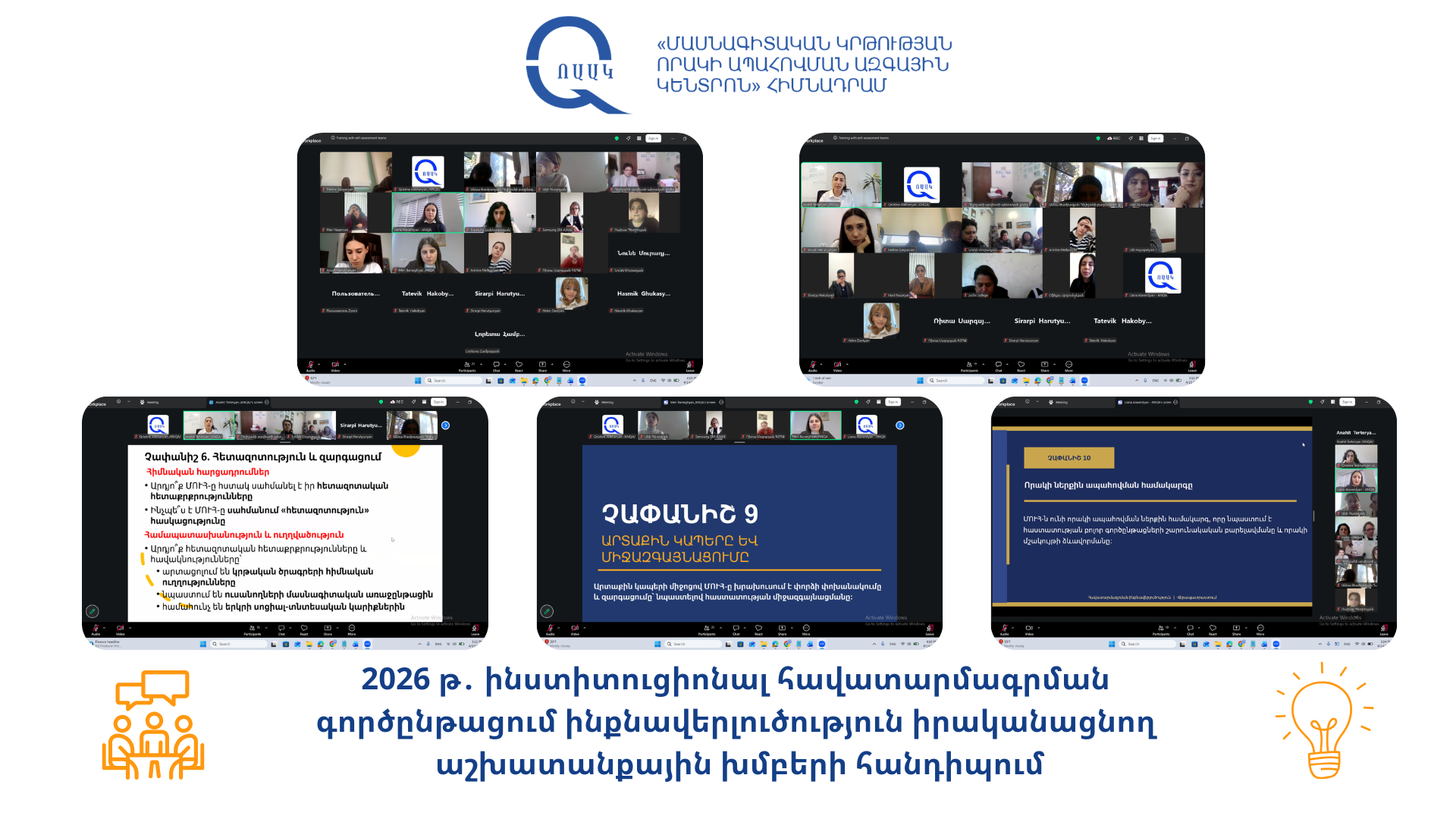
On April 14–15, ANQA's specialists conducted a thematic training for staff members of VET institutions undergoing institutional accreditation.
The participants will later join their institutions’ groups responsible for the preparation of self-evaluation and contribute to the analysis of institutional performance against the ten accreditation criteria.
The training started with a summary of the first and second accreditation criteria covered during the previous training. The participants raised questions arising from the self-evaluation process and received relevant professional clarifications.
During the two-day training, the sixth, ninth and tenth accreditation criteria were also presented, with a focus on the following areas:
- Research and Development;
- External Relations and Internationalization;
- Internal Quality Assurance System.
During the training, participants explored the role of research in VET institutions. ANQA’s specialists noted that research should be understood as a targeted process aimed at the quality enhancement of professional practice. Research activities should be linked to students’ fields of studie and contribute to the development of their professional competences. Particular emphasis was placed on student independence, including the ability to make professional decisions, conduct analysis and collect data during the research process. The role of teachers in research was also emphasised, particularly the value of their professional experience. Teachers should be motivated to examine best practices in their field and keep abreast of developments in the profession.
Key highlights:
- Research is embedded in the learning process rather than conducted as a separate activity.
- It is aimed at the enhancement of a specific outcome or process.
- It fosters the development of professional decision-making skills.
Through its external relations, a VET institution facilitates the exchange of practice and institutional development, thereby contributing to its internationalisation. Key question: Do the VET institution’s external relations foster the modernisation of academic programmes (APs), their alignment with labour market needs, the development of students’ practical competences and professional preparedness, the upgrading of resources and the exchange of international practice?
Key highlights:
- Modernisation of APs: regular updating and enhancement of programmes in line with international standards.
- Alignment with labour market needs: programme adaptation to respond to the current and future needs of employers.
- Students’ practical competences: opportunities for practical experience and internships in real professional settings.
- Upgrading of resources: use of cutting-edge technologies, laboratories and material resources.
- Development of international partnerships: active cooperation with foreign education institutions.
It was also noted that VET institutions have an internal quality assurance system that supports the continuous enhancement of all institutional processes and the development of a quality culture.
Key highlights
- The structure and functions of the VET institutions' internal quality assurance system are presented, along with its role in the enhancement of educational processes.
- The complete sequence of QA processes is described and analysed, from data collection and analysis to decision-making.
- The key documents regulating the system (policy, manual, procedures) and the mechanisms for their implementation are introduced.
It was noted that another meeting is planned to facilitate more effective preparation for the accreditation process.
Accreditation is a continuous process that is aimed at the sustainable development of education quality and the effective performance of institutions.