
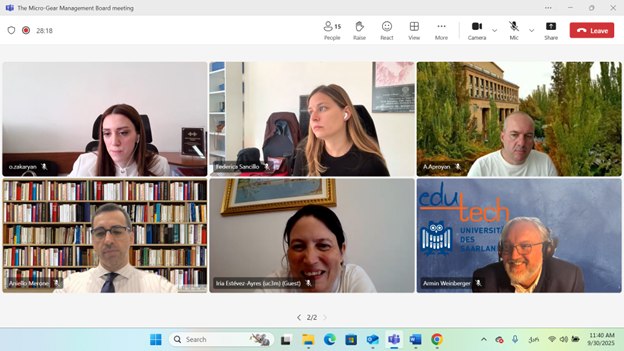
On October 1, another online meeting of the Management Board of the Erasmus+ Micro-GEAR international project took place.
The key purpose was to evaluate current progress and outline next steps.
The main agenda items were:
- Discussion of ongoing activities, with a focus on successful roundtable workshops in the project's partner countries, Armenia and Georgia.
- Development of a micro-credentials guide, including an update on the Georgian NCEQE's activities towards this direction. The guide aims to help education institutions introduce short-term, officially qualifications (micro-certifications).
- Planning of upcoming events, addressing organisational and content-related issues of the workshops scheduled in Madrid (organised by UC3M) and Saarbrücken (organised by GIRAF).
Future plans and actions were also discussed to ensure continuity of the process and effective cooperation.
Micro-GEAR (Micro-credentials for Higher Education Systems of Armenia and Georgia) is a three-year (2024-2027) Erasmus+ project supporting structural reforms in the higher education sector of the South Caucasus region, primarily focusing on Georgia and Armenia, with the aim of introducing and facilitating the broad proliferation of micro-credentials as a tool for improving relevance, quality and flexibility of higher education. In line with the European Council’s Recommendation on a European approach to micro-credentials for lifelong learning and employability, the project will update the National Qualifications Frameworks in both countries, build national consensus over principles of micro-credentialing, stimulate educational activities leading to micro-credentials and facilitate their mutual recognition.
As part of the project, the involved HEIs will develop and pilot micro-credentials with the support of partners.