



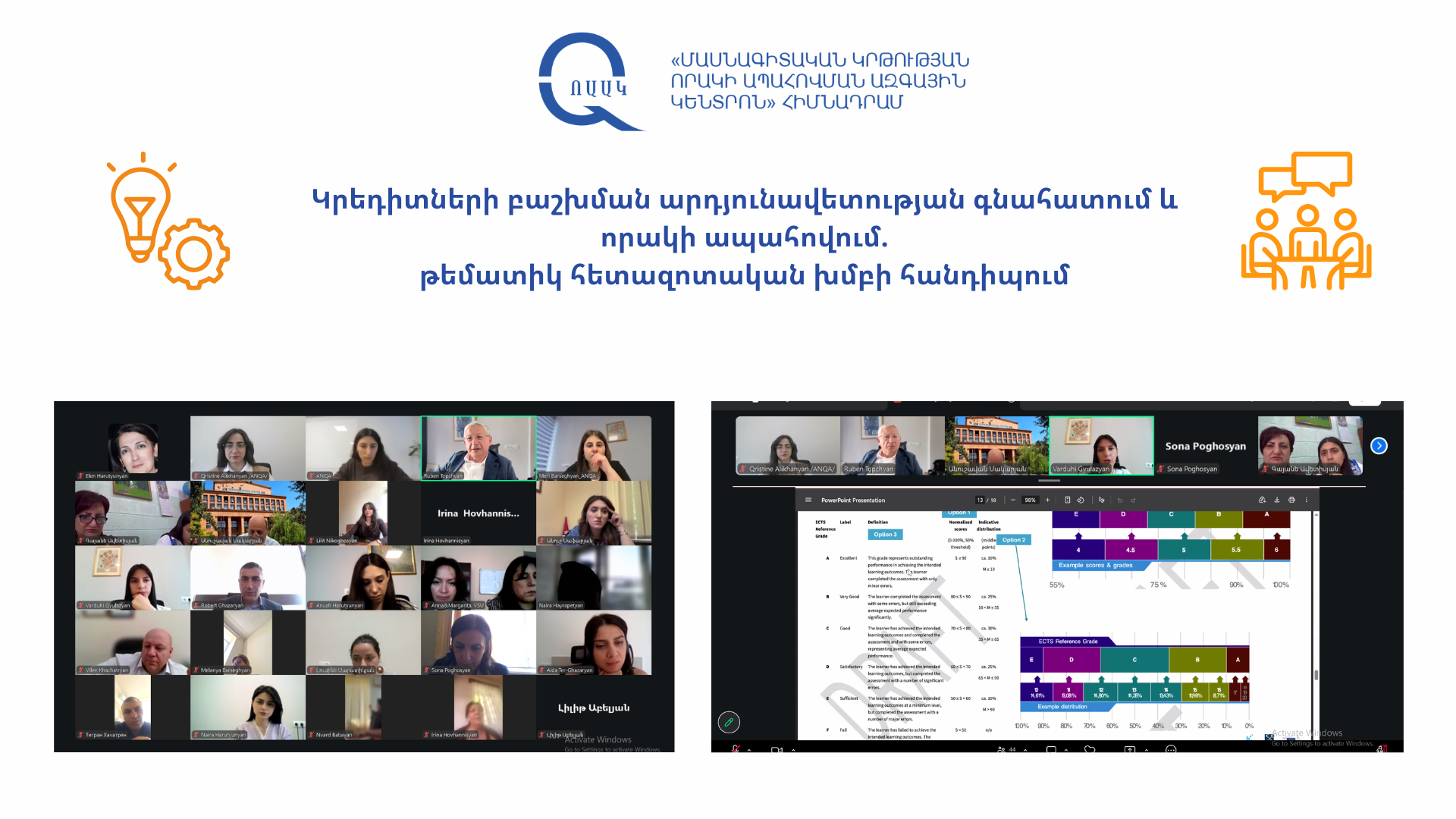
On May 11, ANQA held the first meeting of the thematic research group “Evaluation of the Effectiveness of Credit Allocation and Quality Assurance” as part of the “Self-Audit of Academic Programmes” project.
The meeting brought together HEIs' academic programme (AP) managers, teaching staff and QA managers. The discussion aimed to jointly analyse the credit allocation within APs, the extent to which credit allocation reflects students’ actual workload and the impact of the credit system on knowledge acquisition, competence development and the achievement of AP learning outcomes.
The discussion focused on the principle that credits should not be viewed merely as a calculation of study hours, but as a tool that links student workload, intended learning outcomes and competences.
Project objective: development of a practical model for self-audit
The meeting was part of ANQA’s series of professional discussions, aiming to jointly develop a practical model for AP self-audit with HEIs. The project seeks to foster a culture of periodic, data-driven and outcome-based evaluation of APs' HEIs, focusing not only on document compliance but also APs’ actual impact on student learning and competences.
Credit allocation: from study hours to learning outcomes
During the discussion, participants addressed current approaches to credit allocation and its justification. It was highlighted that while APs generally specify the number of credits assigned to courses, the basis for the allocation of a particular credit value to each course is not always sufficiently substantiated.
In this context, it was emphasised that credit allocation should be based not only on the number of contact hours, but also on:
- the course objectives;
- the intended learning outcomes;
- the teaching and assessment methods;
- the volume of students’ independent work;
- the overall effort required from students.
Student workload at the core of effective credit allocation
Participants drew attention to the fact that the duration of class hours and the volume of students’ independent study may be interpreted differently across HEIs. As a result, courses with the same number of credits may vary significantly in terms of classroom activities, independent study and the overall effort required from students.
One of the key conclusions of the discussion was that the effectiveness of credit allocation should be evaluated beyond formal study hours, taking into consideration students’ actual workload and the achievement of learning outcomes.
Student experience as a key data source
Particular emphasis was placed on the study of student experience. Participants discussed how student feedback can provide valuable insights into:
- the time and effort required by the course;
- the effectiveness of teaching and assessment methods;
- whether students acquire the intended knowledge, competences and skills;
- the challenges students encounter in independent study and assessment processes.
This approach is particularly important to ensure that credits are viewed as a tool that links students’ learning outcomes with their workload.
International context and ECTS system
The discussion also addressed international practices and the specific features of the ECTS system. It was noted that the credit system is intended to ensure the comparability of learning outcomes in different HEIs and education systems.
Meanwhile, it was highlighted that the numerical equivalence of credits or grades alone is not sufficient to ensure the comparability of educational content. Therefore, particular importance should be attached to clear definition of learning outcomes, a realistic evaluation of student workload and the consistent application of assessment approaches.
The discussion also reflects current international developments in approaches to ECTS implementation, which emphasises student-centred learning, the achievement of learning outcomes and the evaluation of students’ actual workload.
Small and large credit blocks: flexibility, depth and comparability
Participants also addressed the effectiveness of courses with small and large credit blocks. It was noted that larger credit blocks may enable students to engage more intensively and in greater depth with particular assignments, while courses with a lower credit value may contribute to programme flexibility, international mobility and the comparability of programmes across different HEIs.
Meanwhile, it was emphasised that the effectiveness of each approach should be evaluated in terms of the extent to which it contributes to a balanced student workload, competence development and the achievement of AP learning outcomes.
Data-Driven decisions for AP enhancement
The meeting also highlighted the importance of the development of data-driven approaches. It was noted that informed decisions on the effectiveness of credit allocation require the collection and analysis of data on student workload, the impact of teaching methods, assessment results, the volume of independent study and the achievement of learning outcomes.
In this context, HEIs’ QA units have an important role in promoting internal studies, facilitating discussions with teaching staff and students and supporting the APs' periodic review.
Next step: development of a toolset applicable to HEIs
At the end of the meeting, the participants highlighted that the effective implementation of the credit system cannot be limited to the formal calculation of study hours. Credit allocation should reflect students’ actual workload, the achievement of learning outcomes, the effectiveness of teaching and assessment methods, as well as the overall coherence of the academic programme.
Building on the outcomes of the thematic research group, a model applicable to HEIs is expected to be developed, incorporating tools and mechanisms for the evaluation of the effectiveness of credit allocation in APs and quality assurance.
The model aims to support HEIs in viewing credit allocation not only as a structural component of an AP, but also as a tool for the evaluation of the link between the education quality, student workload and competence development.