



In vocational education, students should not only acquire the skills required for professional tasks, but also learn to examine workplace situations, work with data and understand the factors that lead to different outcomes.
Research assignments are designed to develop these competencies and ANQA continues to encourage VET institutions to incorporate them into the learning process.
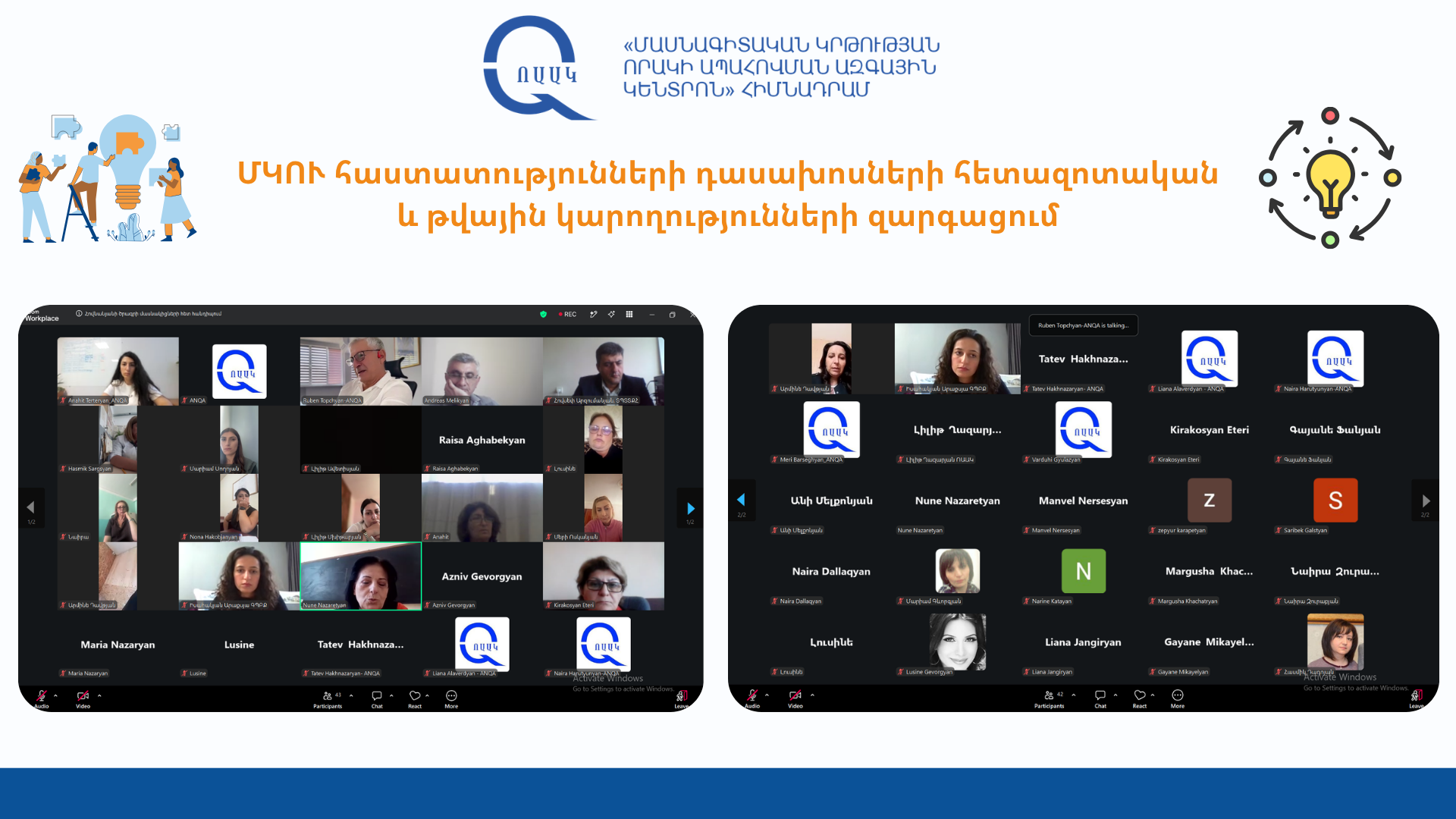
On September 11, ANQA held an online meeting to discuss the practical application of this approach with teachers who had completed training as part of the “Building Innovative Teaching Capacities in VET (Development of Research and Digital Skills)” project, implemented with the support of the H. Hovnanian Family Foundation.
Following the training, the teachers integrated the research assignments they had developed into their courses and internship activities. The meeting focused on what had worked well, the challenges faced by teachers and students and the enhancement areas. Particular emphasis was placed on the students’ ability to work independently with data and substantiate their conclusions.
The experience has shown that research activities are most effective when they are directly linked to the topic under discussion and to students’ future professional practice. This process also reshapes the teacher’s role. Rather than providing ready-made answers, the teacher guides the student, acting as a moderator and facilitator. At the initial stage, students require more guidance, while over time they gradually become more independent in their work.
The discussions also demonstrated the importance of clear assignments for student engagement. Students need to understand what they are expected to study, the data they need and the expected outcomes to achieve.
Meanwhile, student research does not necessarily have to be complex or large-scale. It may start with a simple question arising from professional practice: why does one situation lead to a better outcome than another, what factors influence the difference, and what could be changed? The question may be raised by the student, the teacher, or formulated jointly. The key is to help students learn about data to identify causes and relationships and to draw evidence-based conclusions.
This approach enables students not only to identify problems, but also to understand what works well, what does not, and why. In this way, research becomes a tool for understanding professional practice, supporting decision-making and contributing to its enhancement.
In the new semester, teachers will continue to apply and further develop research-based assignments, including them in internship activities where possible. Regular discussions will also continue to reflect on the accumulated experience, share effective approaches and find solutions to emerging challenges.