
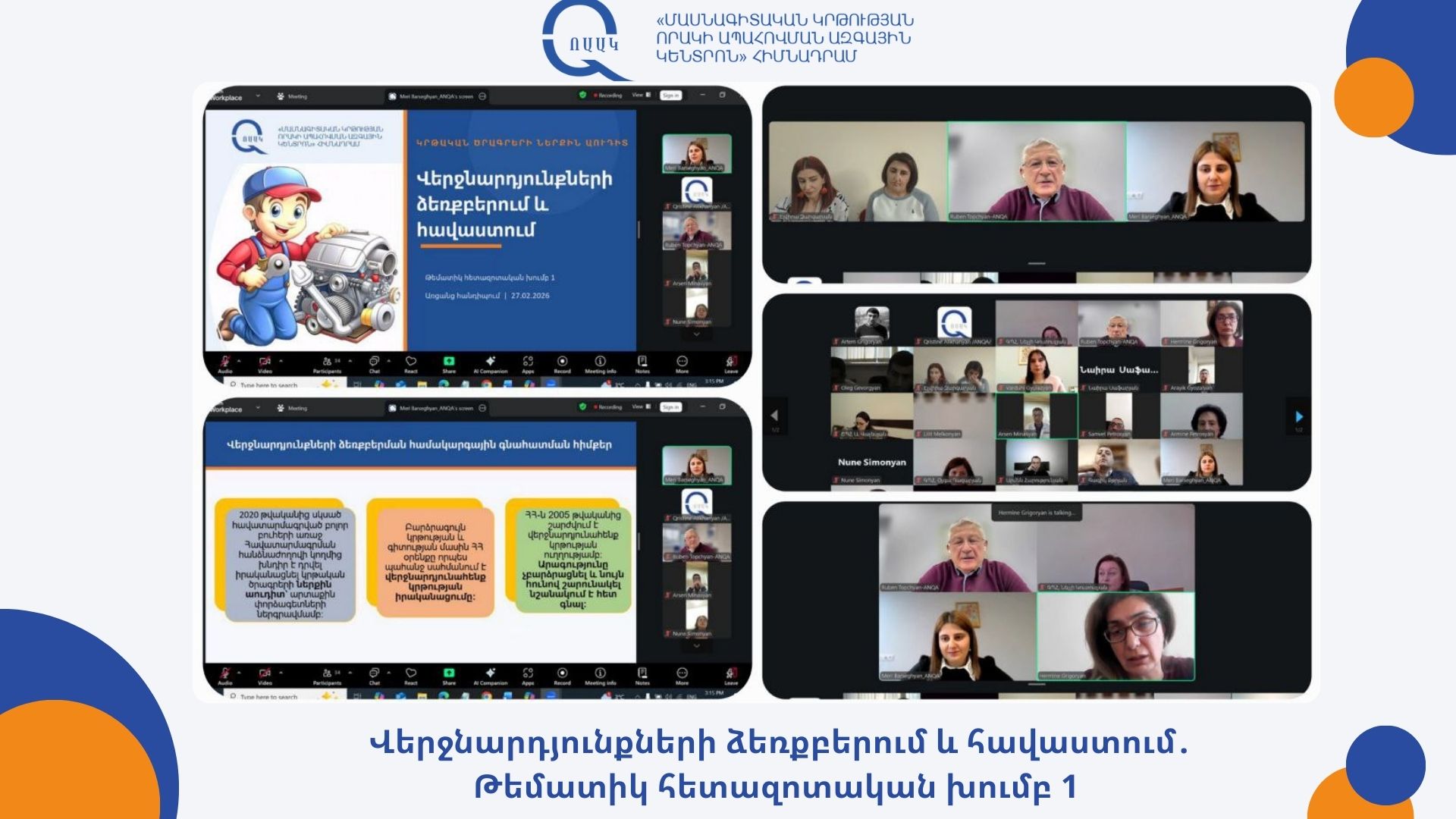
On February 27, a meeting of representatives from the thematic research group “Achievement and Verification of Outcomes” was held as part of the “Self-Audit of Academic Programmes” project. The discussion brought together academic programme (AP) managers, teachers and QA managers from HEIs to jointly analyse the mechanisms for the achievement and verification of AP learning outcomes.
The meeting was a continuation of ANQA's series of professional discussions held as part of the “Self-Audit of Academic Programmes” project and aimed at the development of a practical model for AP self-audit in HEIs.
Systemic foundations of outcome-based education
The meeting opened with the presentation of systemic foundations for the assessment of learning outcomes. It was noted that, since 2020, the Accreditation Committee has required all accredited HEIs to conduct AP self-audits with the involvement of external experts. It was also emphasised that the RA Law on Higher Education and Science requires the implementation of outcome-based education.
The discussion aimed to develop common approaches for the demonstration and evidence that the AP learning outcomes are actually achieved throughout the learning process.
Approaches for the achievement and assessment of outcomes
HEI representatives shared their practice in the implemantation of mechanisms for the outcome assessment and achievement. It was noted that the process requires clearly formulated and measurable learning outcomes. HEIs use a range of tools to verify their achievement, including continuous assessment, thematic assignments, projects, and, in some fields, standardised assessment methods such as OSCE.
Participants also highlighted that the assessment of learning outcomes should not be limited to the final stage of the programme. Assessments conducted throughout the learning process should be aligned with the APs' ultimate goals, while intermediate assessments should ensure the gradual achievement of the intended learning outcomes.
An approach was also presented whereby a common model for the outcome assessment could be developed based on the following components:
- mapping of course learning outcomes to programme learning outcomes;
- selection of relevant teaching methods;
- application of standardised assessment methods;
- analysis of the collected data and implementation of mechanisms for continuous enhancement.
Data collection and distribution of responsibilities
Another key topic of discussion concerned the data required to verify the achievement of learning outcomes. It was noted that such data are generated throughout the learning process and may include students’ independent research activities, interdisciplinary projects, continuous assessment results and evidence obtained through other assessment tools.
HEI representatives also highlighted the key role of the AP manager in this process, particularly in overseeing the programme structure and ensuring the alignment of courses, thematic plans and assessment mechanisms with the programme learning outcomes.
Where issues are identified, AP managers and academic teams revise the assessment methods and course structure to support the continuous enhancement of the learning process.
The discussion ended with participants highlighting the importance of the consolidation of HEIs’ practices, and, at ANQA’s suggestion, it was agreed to further discuss common approaches to the assessment of the achievement of learning outcomes, irrespective of individual HEIs’ internal regulations
As a result of the thematic research group’s work, it is planned to develop an applicable and acceptable model for HEIs that includes tools and mechanisms for the definition, achievement and verification of AP outcomes.