
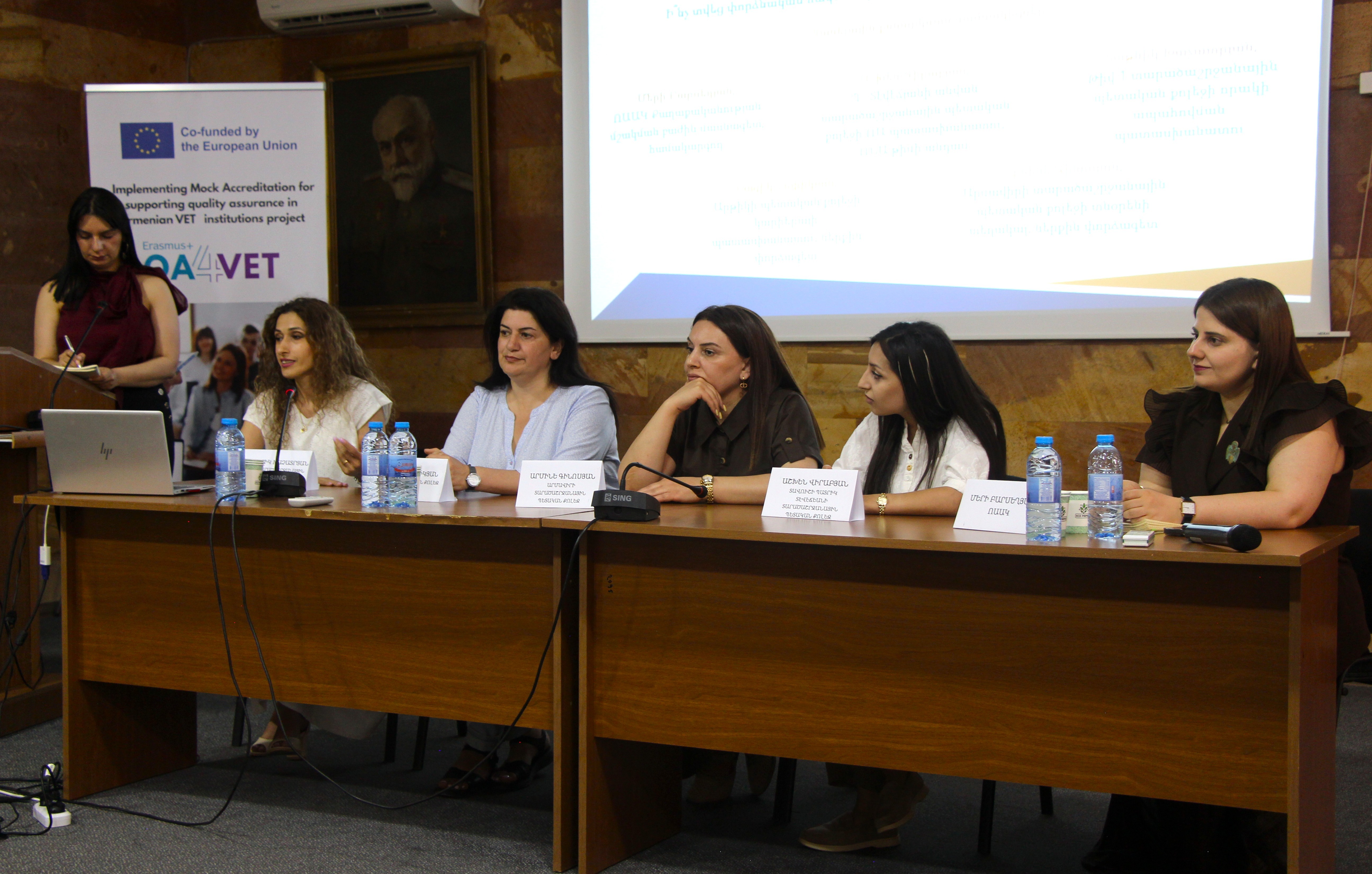
The final workshop on the outcomes of the mock accreditation conducted as part of the Erasmus+ QA4VET project included a panel discussion. The discussion was moderated by Varduhi Gyulazyan, head of ANQA’s Institutional and Programme Accreditation Division. The panel brought together representatives from the VET institutions involved in the mock accreditation, internal experts, ANQA's specialists and project partners to share their experiences from the process, the changes achieved and further development opportunities.
Participants addressed the following key topics:
- Mock accreditation's impact on VET institutions: It was highlighted that the process fostered new QA approaches, positioning it as a tool for institutional management and continuous enhancement rather than merely a means of preparation for accreditation.
- Development of professional dialogue and cooperation: It was noted that the project provided an effective platform for VET institutions to exchange practices and learn from each other.
- A new understanding of self-evaluation and SWOT analysis: Participants highlighted a shift in perspective, with weaknesses being viewed not as shortcomings, but as opportunities for further development and enhancement.
- The role of internal experts: The discussion focused on internal experts' contribution to the identification of challenges, data analysis and preparation of enhancement-driven recommendations, with an emphasis on their role as partners rather than as supervisors.
- Data-driven decision-making: It was highlighted that the process has fostered a culture of data collection and analysis, resulting in more informed governance decisions.
- QA decentralisation: It was noted that quality assurance has gradually become a shared responsibility across the institution, involving different units and stakeholders.
- Capacity building: The project's capacity building component was also highlighted, with particular emphasis on self-evaluation, data collection and analysis skills.
- Sustainability of expert capacity and project outcomes: Participants attached importance to the continued engagement of the established network of internal experts, as well as the dissemination of the project tools and methodology across other VET institutions.
One of the key project achievements is that mock accreditation is viewed not as a one-time evaluation, but as a continuous development tool. The approaches and tools developed as part of the project can continue to be used by VET institutions to evaluate their progress, identify enhancement areas and systematically enhance the education quality.
The key message was that a genuine QA culture is built when institutions are prepared to openly discuss their strengths and enhancement areas, learn from their own experience and work collaboratively towards a higher-quality educational environment.