
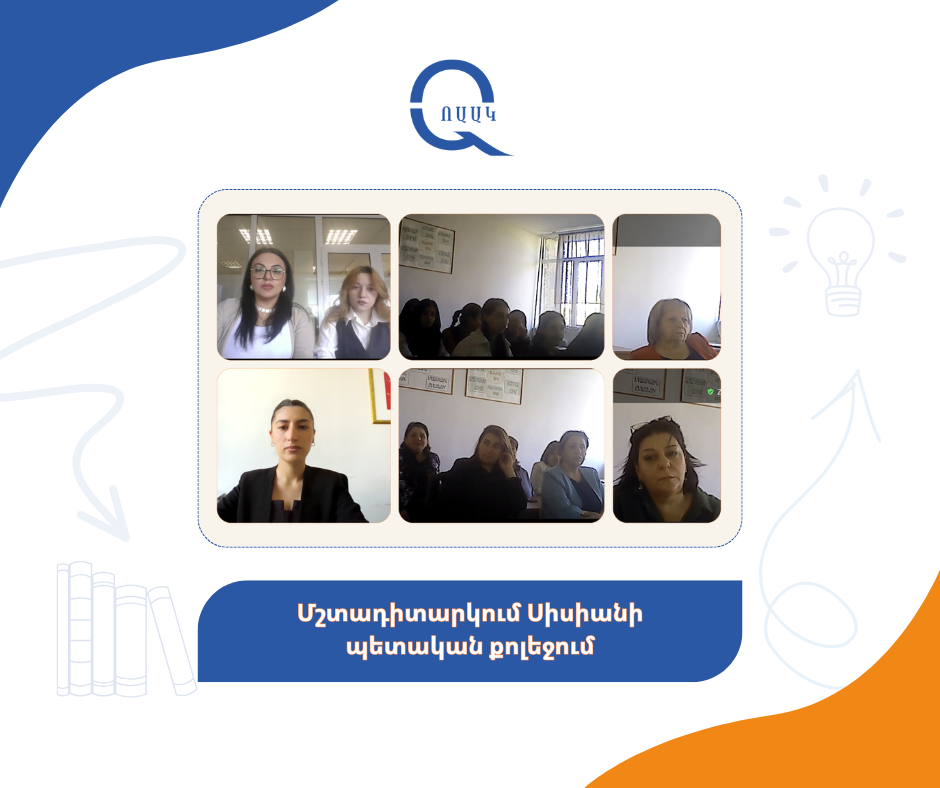
On October 9, ANQA conducted an online monitoring of the internal quality assurance system at the Sisian State College. The goal was to observe the education institution’s QA processes and the resulting changes.
As part of the online monitoring, meetings were held with the education institution’s management staff, heads of chairs, teachers and students.
The monitoring focused on the following issues:
- Teaching staff’s stability
The discussion covered the policy for the recruitment of young specialists, steps towards the teachers’ capacity building and organization of professional trainings.
- Development plans and external partnerships
The observations examined the development plans and external partnerships supporting the institutional capacity building and resource replenishment.
- Cooperation with employers
The discussion addressed the level of employer involvement in the educational process, the use of employer resources, the internships, the students’ hands-on experience in the employer settings, and the institutions mechanisms for receiving and responding to the labour market signals.
- Resources
The observations explored how well the institution is equipped with laboratories, modern professional literature and classroom facilities to ensure the effective implementation of the academic programmes.
- Student employment
The discussion focused on the percentage of graduates employed in their field, the institution's mechanisms for the observation of labour market trends and the implementation of graduate tracking.
At the end of the monitoring, ANQA’s specialists summarised the key outcomes of the meeting with the education institution’s management staff, highlighting the enhancement areas.
In particular:
- Importance was attached to increasing the number of analytical and comparative student assignments that reflect the employer context and foster the development of specialists with a research-oriented mindset, capable of collecting, comparing and analysing data, and drawing evidence-based conclusions.
- Interdisciplinary collaboration was highlighted, particularly in professional foreign language teaching, to help students acquire professional terminology in various languages and apply sector-specific vocabulary in communication.
- It was proposed to develop KPIs to specify priorities and track the effectiveness of their implementation.