
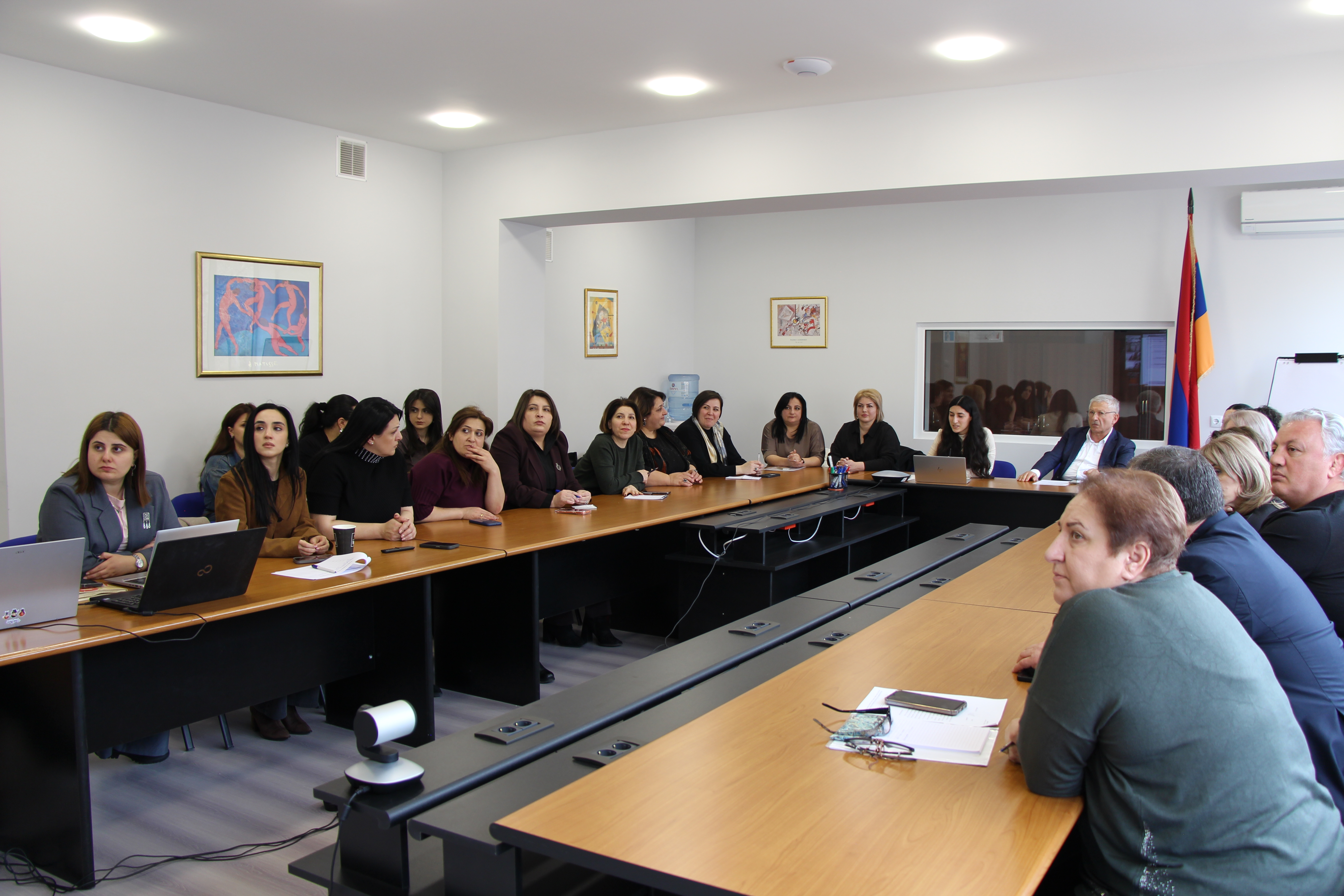

On February 24, ANQA hosted the first working meeting with representatives of VET institutions. The meeting aimed to introduce the pecularities of institutional and programme accreditation processes and prepare the institutions for the upcoming activities. The participants were introduced to the Accreditation Procedure, the relevant processes, and the methodological approaches applied. The discussion highlighted that a number of VET institutions are currently in the reaccreditation process, while others are applying for institutional and programme accreditation for the first time. The meeting was particularly important for institutions applying for accreditation for the first time, as they are not yet familiar with the stages, requirements and procedures of the process. It was emphasised that institutional accreditation is a mandatory prerequisite for programme accreditation. Accordingly, all institutions applying for programme accreditation already hold valid institutional accreditation.
Peculiarities of institutional and programme accreditation
Institutional accreditation evaluates the institution’s overall performance against ten criteria. The evaluation covers governance mechanisms, strategic planning, the educational environment, resources and the QA system. In the case of institutions undergoing reaccreditation, particular emphasis is placed on an outcomes-based approach, requiring the demonstration of post-accreditation progress, the implemented enhancements and their measurable outcomes. Programme accreditation focuses on the evaluation of academic programme (AP) quality and has a more in-depth and practice-oriented direction. The student is at the centre of the evaluation, with a focus on the achievement of learning outcomes and the development of professional competences. Previous experience with programme accreditation has shown that the following issues are often identified at programme level:
- inconsistencies in students’ practical preparedness;
- insufficient specification of teaching methods;
- insufficiently substantiated assessment mechanisms.
At this stage, an understanding is developed of the knowledge and skills students actually acquire and how they apply them in the professional field.
It was highlighted that data-driven analysis is currently a key priority in the accreditation process. All statements should be supported by quantitative and qualitative data, including survey results, assessment indicators, examination and practical internship data, as well as benchmarking.
The meeting also addressed the activities of the institutions’ quality assurance units. It was emphasised that an effectively functioning QA system, together with the survey findings, should form a fundamental part of the self-evaluation process.
To support the effective implementation of the accreditation process, three- to four-day workshops and meetings are planned. Training on institutional and programme accreditation will be organised separately, considering their differences in content and methodology. Additional consultation meetings will also be arranged to address ongoing issues and ensure the effective organisation of the activities.