
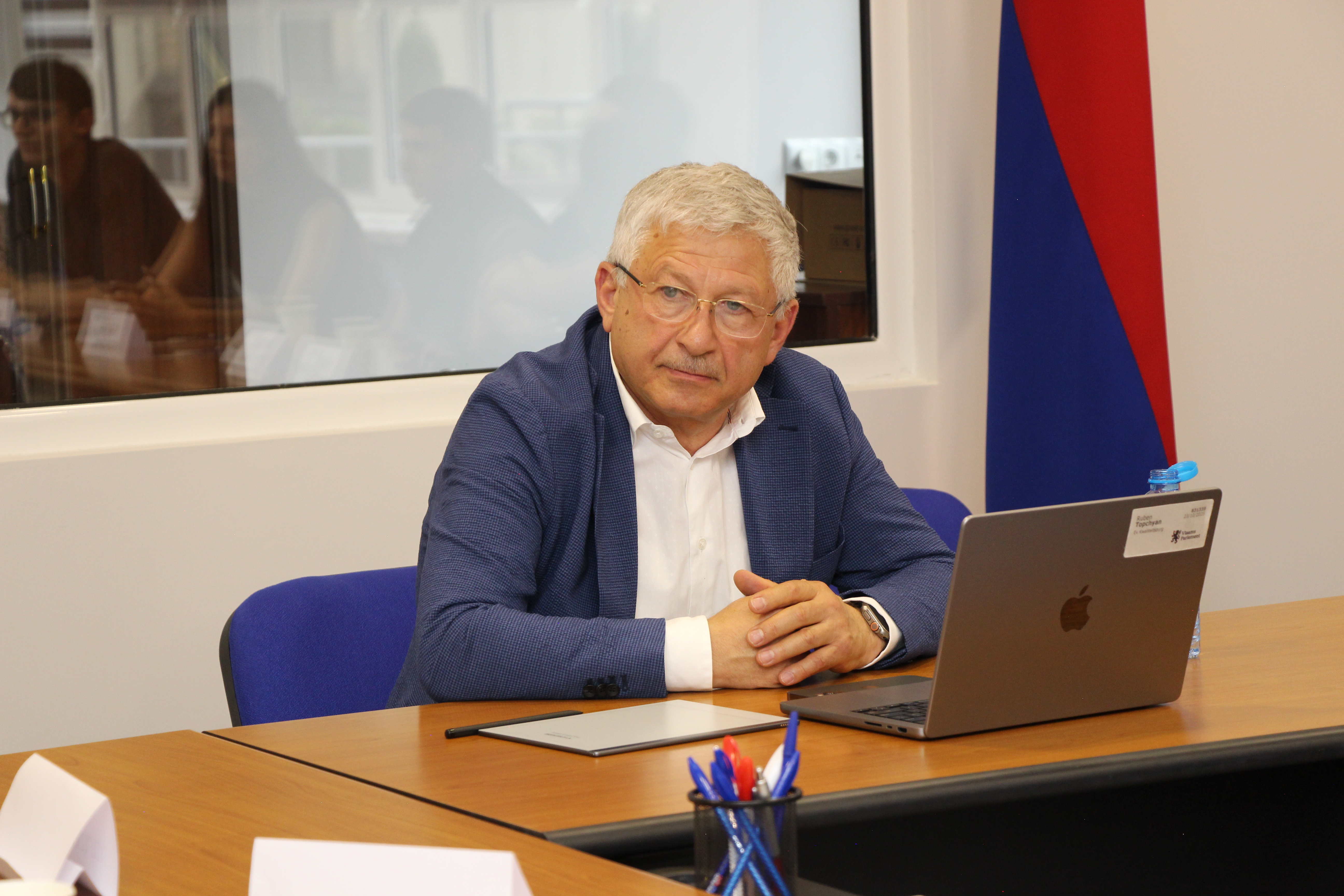



ANQA discussed the principles of questioning and outcome-based analysis in the accreditation process with students. On May 12, ANQA held a meeting with students as part of the “Students’ Voice” project. The workshop was led by Ruben Topchyan, ANQA's acting director.
The meeting focused on how student experts can use questioning during the accreditation process to identify the actual outcomes of HEIs' educational activities, including whether academic programmes (APs) develop the competences defined by their intended learning outcomes, and whether HEIs have mechanisms for the evaluation, analysis and enhancement of these outcomes.
The discussions highlighted that HEIs’ responsibility begins with a clear yet fundamental answer to the question: what competences will students acquire upon AP completion? From this perspective, the education quality should be evaluated not only through the delivered courses, implemented processes, or available documents, but also through the outcomes students achieve upon completion of their studies.
During the workshop, students explored the key areas that support the transition of the accreditation process from a descriptive approach to an outcome-based analytical approach.
Clarification of the question’s objective
Before questioning, student experts should clearly understand what they intend to explore, the information needed and how that will support the analysis. Question formulation was viewed not as an isolated activity, but as the first step in an analytical process leading to evidence and a well-founded conclusion.
Thematic sequencing of questions
The discussions highlighted the importance of a specific thematic area and the same line of questioning during the meetings with different stakeholder groups. This approach allows experts to compare stakeholder responses and evaluate the extent to which institutional processes are systematic and consistent.
Formulation of evidence
Particular emphasis was placed on the fact that, in the accreditation process, evidence cannot be based on a single response or an individual opinion. Instead, it should be formulated through the analysis and cross-checking of information from multiple sources. This competence is especially important when experts are expected to evaluate not only the existence of a process but also its effectiveness.
Preparation of outcome-based expert panel report
The discussions with students highlighted that an accreditation report should go beyond process description and provide an analysis demonstrating the outcomes of institutional actions, the identified issues and the required enhancements. In this context, particular importance was attached to a clear link between outcomes, evidence and conclusions.
The HEIs' responsibility for the preparation of competent professionals
The discussions highlighted that HEIs should be able to clearly demonstrate the competences and professional skills developed through an AP. This approach is important for applicants' informed choices, student learning and employer expectations.
Indicators of effective teaching
The following were identified as key indicators of effective teaching at HEIs:
- clear definition of the AP learning outcomes;
- alignment of teaching and assessment methods with the learning outcomes;
- collection and analysis of data on student progress;
- feedback from employers and alumni;
- connection between teachers’ professional development and the formation of student competences.
The importance of teacher professional development
It was emphasised that teacher professional development should not only focus on the enhancement of teaching methods but also contribute to the development of a teaching and assessment culture that supports the preparation of competent professionals. In this context, particular importance was attached to HEIs' ability to demonstrate the link between the development of teachers’ capacities, AP learning outcomes and student achievement.
Ruben Topchyan noted that, in the accreditation process, questioning is not merely a means of data collection but also an analytical tool. A well-formulated question makes it possible to determine whether the HEIs’ processes actually contribute to the enhancement of education quality and the development of student competences.
Reference was also made to the quality assurance as a tool for managing diversity. It was highlighted that quality is reflected in an HEI's capacity to respond to the diverse needs of students, APs, the labour market and the broader environment, collect and analyse relevant data and use the findings for the continuous enhancement of its processes.
The workshop enabled students to further develop their understanding of questioning, evidence formulation and outcome-based analysis within the accreditation process.