
How can we ensure that students have actually achieved the intended learning outcomes of an academic programme (AP)? How can teaching and assessment approaches be reshaped to enable students not only to acquire knowledge but also apply it? What role does external quality assurance (EQA) play in the implementation of these changes?
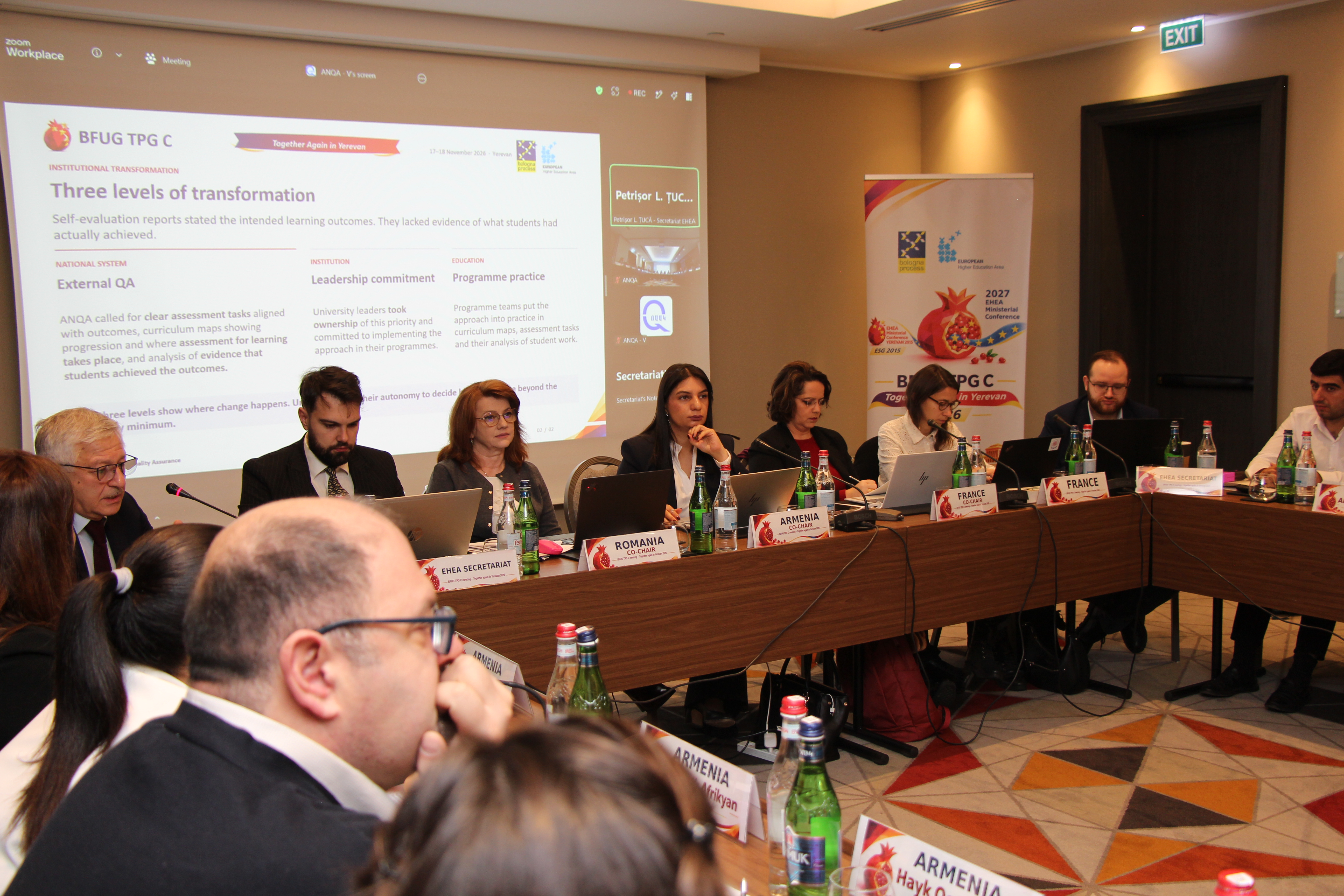
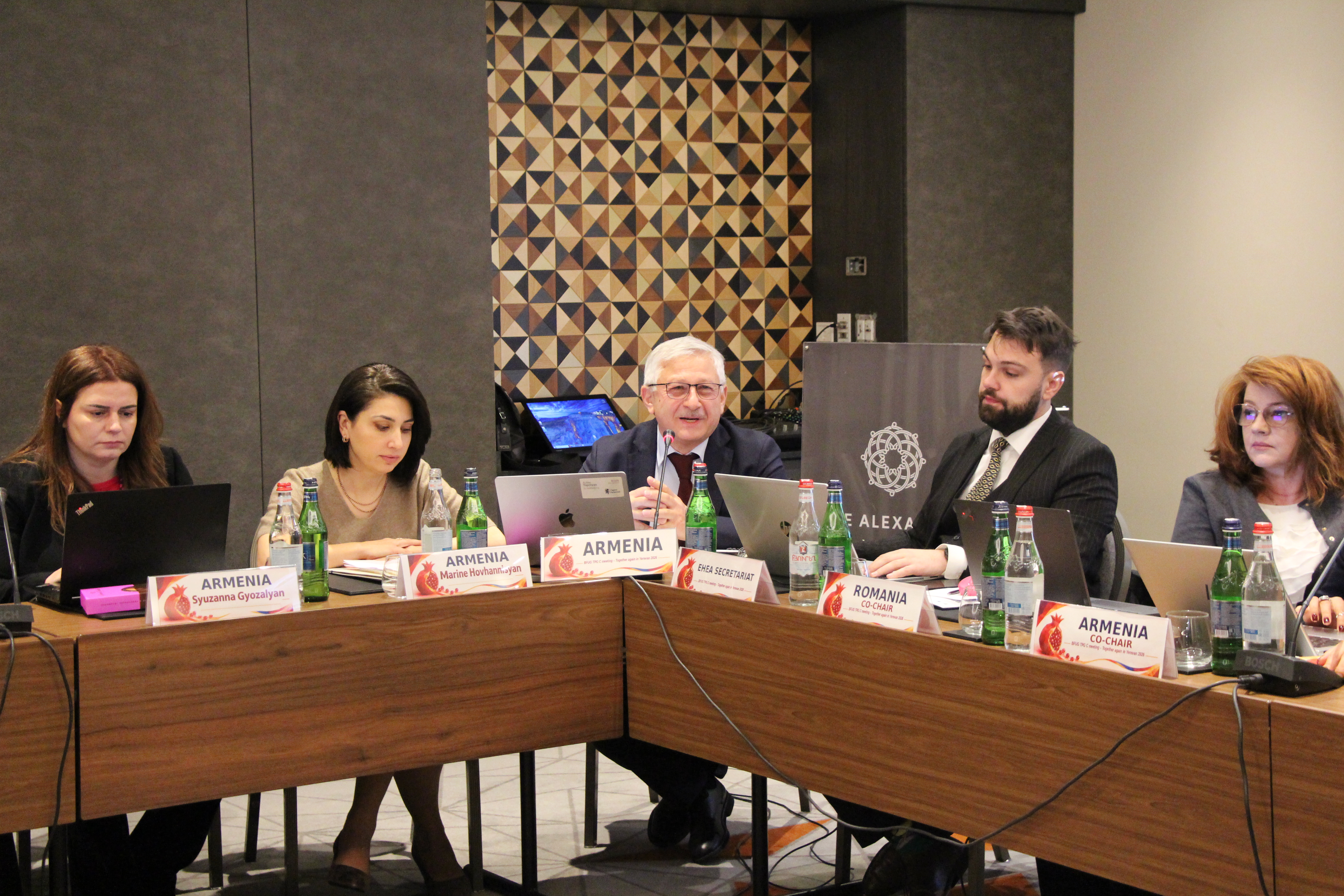
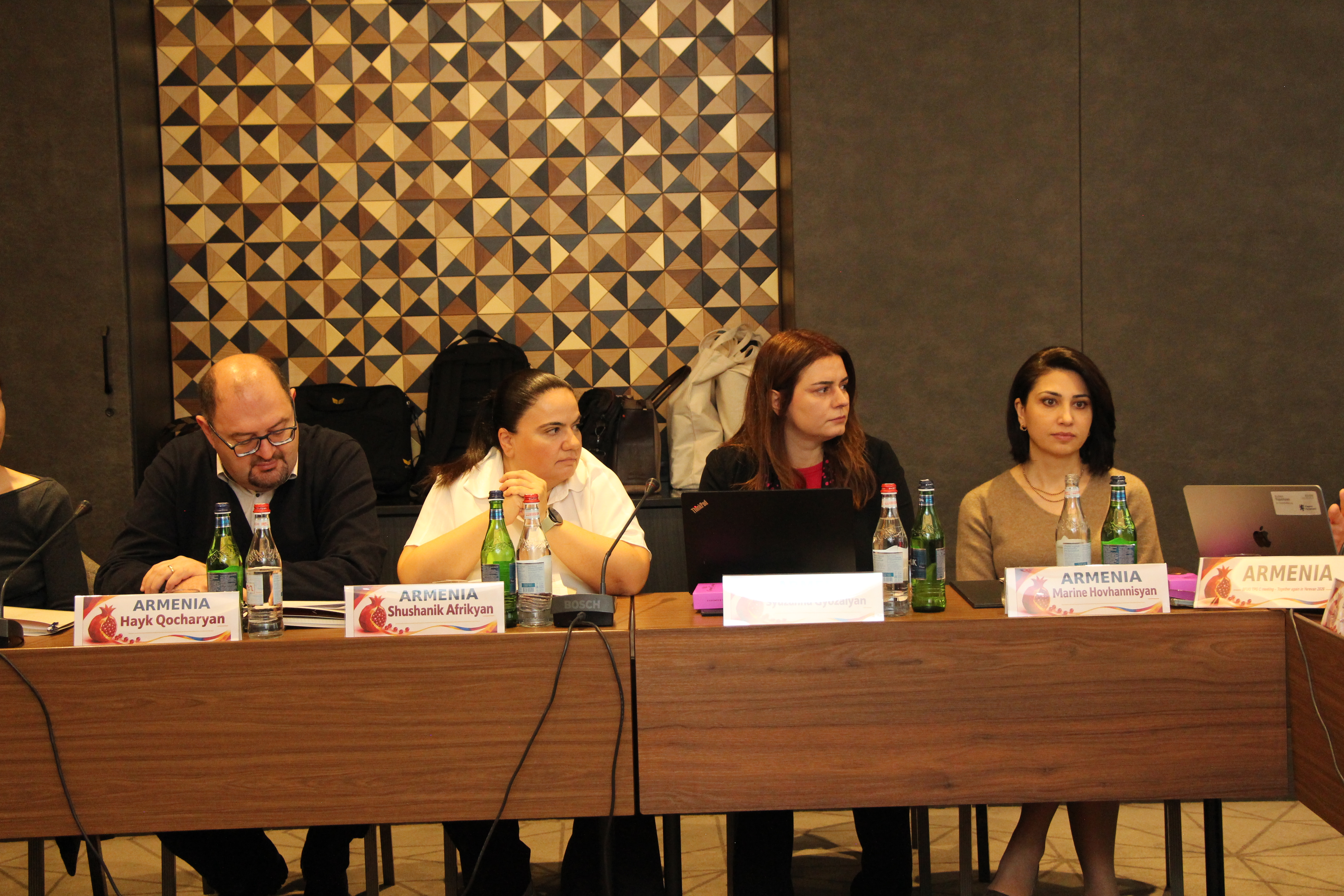
These questions were the focus of a thematic discussion held on November 18 in Yerevan as part of the fifth meeting of the Bologna Thematic Peer Group C on Quality Assurance (TPG C on QA).
During the panel discussion “Evidence of learning outcomes attainment: its role in effective self-evaluation”, representatives from three Armenian HEIs presented their AP enhancement practices to European partners, highlighting the implemented changes, achievements and challenges.
Opening the discussion, Varduhi Gyulazyan, head of ANQA’s Institutional and Programme Accreditation Division and co-chair of the TPG C on QA, underscored the importance of outcomes-based education in higher education QA and continuous enhancement. Ms. Gyulazyan highlighted the panel discussion as an opportunity to share the practices of Armenian HEIs with European partners and foster professional dialogue on approaches to the AP enhancement and the challenges involved.
Ruben Topchyan, ANQA's director, addressed the ongoing reforms in Armenia’s higher education quality assurance system, the introduction of mandatory programme accreditation and the importance of the actual attainment of learning outcomes.
It was highlighted that the definition of the AP learning outcomes does not in itself demonstrate their attainment. Though Armenian HEIs have defined learning outcomes since 2006, teaching and assessment practices often remain content-driven rather than outcomes-based. In this regard, importance was attached to the mapping of the gradual development of student competencies, the design of relevant assessment tasks and criteria and the identification of evidence that verifies learning outcomes attainment.
Armenian HEIs' practices: what is changing in APs?
The presentation by the National University of Architecture and Construction of Armenia focused on a proposed model for the AP enhancement in the field of construction, taking the knowledge and competencies expected of graduates, rather than the subjects taught, as its starting point.
The presentation outlined the approaches to the alignment of AP and course learning outcomes, the revision of the curriculum, the introduction of integrated projects and the development of assessment tasks and criteria. A roadmap for the implementation of the proposed changes was also developed, setting out the sequence of activities, timelines and allocation of responsibilities.
A practical example showcased how students can demonstrate the acquired professional competencies through the planning of construction work, the estimation of the required workforce and equipment and the preparation of work schedules. Particular emphasis was placed on the minimum acceptable assessment thresholds, as well as the distinction between acceptable and unacceptable errors in professional assignments.
Representatives of the Yerevan State Medical University after Mkhitar Heratsi shared their practice in the enhancement of the master’s APs "Healthcare Management and Planning" and the "Pharmacy".
In the case of the AP "Healthcare Management and Planning", self-evaluation and professional collaboration with ANQA led to the revision of programme learning outcomes, teaching and assessment methods, shifting the focus from knowledge acquisition to its practical application and the development of professional competencies.
Constructive alignment enabled the mapping of the formation, progressive development and full attainment of each learning outcome across different courses, specifying the student assignments and the evidence required to verify learning outcomes attainment.
In the assessment system, test-based tasks have been supplemented with analytical and application-oriented assignments, while internship reports and assessments by internship supervisors are used to evaluate students’ practical competencies.
As part of the enhancement of the AP “Pharmacy”, emphasis was placed on interdisciplinary learning, the development of practical and research competencies and the diversification of assessment methods. Presentation also covered ongoing efforts to assess students’ practical skills through direct observation, develop simulation tools and integrate AI.
The Yerevan State University’s presentation highlighted the transition from content-driven to outcomes-based education as part of the AP “Arabic Studies”. The self-evaluation process identified inconsistencies between the intended learning outcomes and actual teaching and assessment practices. In response, the programme structure was revised, the link between disciplinary knowledge and the competencies required for its application was more clearly defined and the AP learning outcomes were reformulated.
An important step was the teachers' involvement in the process of change. Following the training, teachers revised their courses, focusing on the alignment of the AP and course learning outcomes, the coherence between teaching and assessment methods, as well as the logical progression and complementarity of courses.
From the AP changes to the development of a quality culture
The Armenian HEIs' practices prompted active professional discussions among European partners. The discussions went beyond the AP structure and assessment tools, addressing the development of a quality culture within HEIs, a shift in the teachers' mindset and the mission of higher education. Particular emphasis was placed on building a unified team of teachers responsible for the AP delivery. Teachers are responsible not only for their individual courses but also for the ensurance of the AP learning outcomes.
The discussions also addressed the employer engagement in the AP development and the definition of assessment criteria.
Ruben Topchyan attached importance to the employer engagement in the definition of minimum acceptable thresholds for professional competencies, the red lines that specify the unacceptable errors in professional practice and the competencies expected by graduates.
The discussions also explored the need to broaden the scope of student engagement, moving beyond the feedback on education to discussions on assessment results, the effectiveness of the applied methods and the actions aimed at the AP enhancement.
International partners also expressed interest in the need to introduce mandatory programme accreditation in Armenia and its impact on the development of internal quality assurance (IQA) systems within HEIs. In this regard, it was highlighted that institutional policies and procedures are not always fully implemented at the level of individual APs. Programme accreditation provides an opportunity to examine these processes in greater depth and identify enhancement areas.
How to assess what is difficult to measure
How can HEIs prepare specialists in line with labour market requirements, while preserving the fundamental academic and research components of higher education? How can critical thinking, independent judgement, intellectual curiosity and the ability to generate new knowledge be assessed without reducing education to easily measurable outcomes?
During the discussions with European partners, it was highlighted that the assessment of learning outcomes is not intended to make every aspect of education measurable.
What matters is that professional judgements about student achievements are well-founded, evidence-based and transparent, recognising learning diversity and complexity.
The Armenian HEIs' practices demonstrate how self-evaluation, accreditation and continuous professional cooperation with ANQA can lead to substantive changes in the AP content, the revision of teaching and assessment methods, the strengthening of teachers’ role and a greater focus on students’ actual learning achievements.
The discussions in Yerevan provided Armenian HEIs with an opportunity not only to share their practices with European partners but also to jointly reflect on challenges relevant to different higher education systems.