

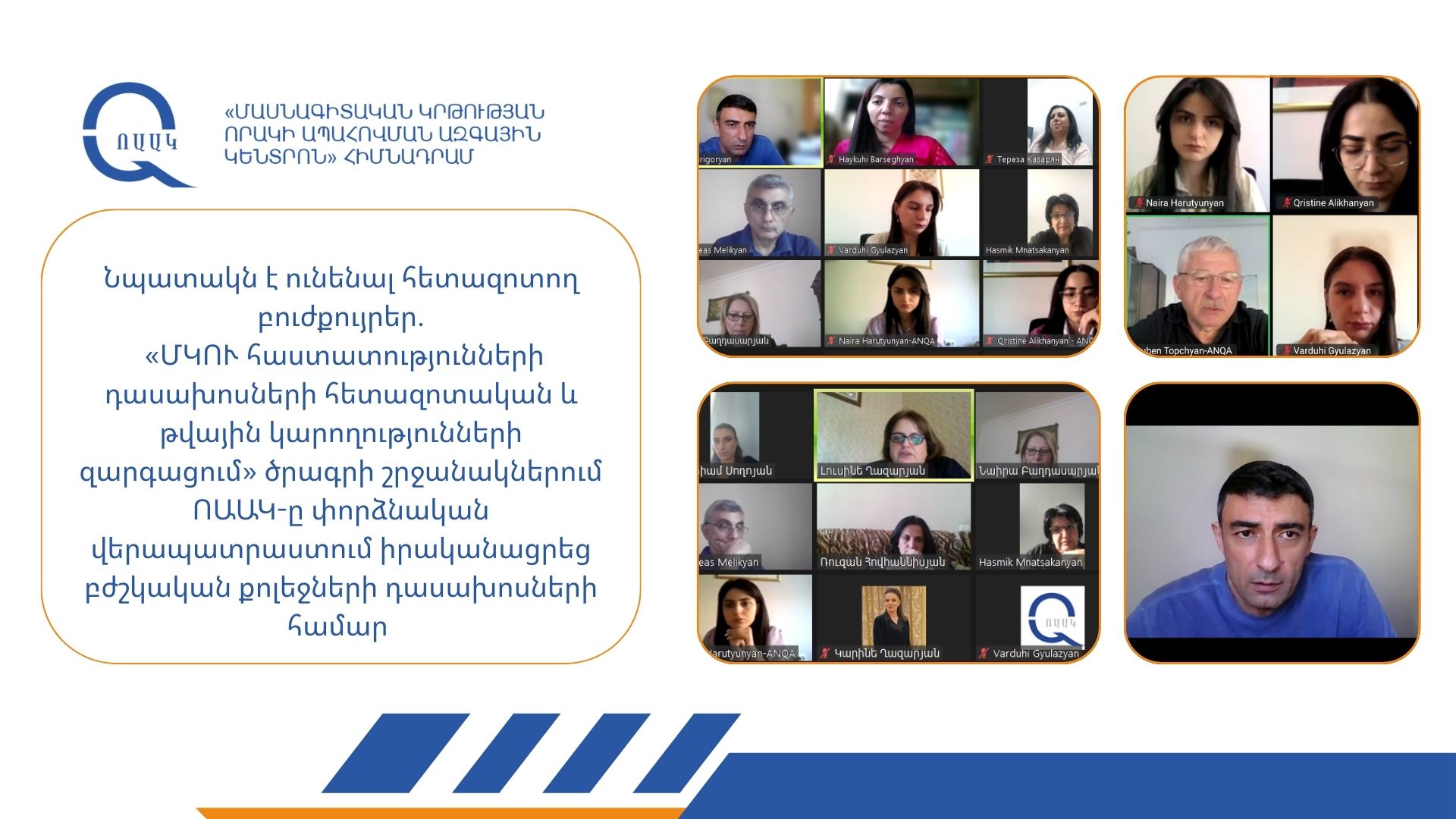
On September 23-24, ANQA organised the first pilot training for the medical VET institutions’ representatives as part of the "Building innovative teaching capacities in VET (development of research and digital skills" project, supported by the H. Hovnanian Family Foundation. During the two-day sessions, the main course materials and approaches were piloted.
The key message of the training was that VET institutions should cultivate reflective nurses, specialists who do not take every piece of information as ultimate truth, but question, formulate hypotheses, investigate, analyse, observe and compare continuously, and draw evidence-based conclusions.
To this end, the training explored how to structure the educational process so that students learn to pose relevant questions, distinguish between reliable and unreliable sources and make informed decisions in clinical settings.
The training was led by Artem Grigoryan, head of the Department of Pathophysiology of Yerevan State Medical University, Candidate of Medical Sciences and a member of ANQA’s Accreditation Committee. The discussions focused on the role of research-oriented thinking in nursing, its key characteristics and steps for its development in the educational process.
The results will guide the refinement of the training materials and support preparations for the project's main stage, targeting the training of over 80 teachers from VET institutions. Pilot trainings for VET teachers in agriculture and IT are also scheduled.
About the project
With the support from the H. Hovnanian Family Foundation, ANQA conducts “Building innovative teaching capacities in VET (development of research and digital skills)” project. The project aims to to equip VET institutions’ teachers with practical research and digital skills, enabling them to independently revise and modernise academic programmes and course descriptors in line with labour market requirements and the National Qualifications Framework.
Expected outcomes:
- 80 teachers from VET institutions in the agricultural, medical and IT sectors will undergo practical training.
- Academic programmes will be revised to be more practical and modern, aligned with the requirements of the labour market.
- Academic programmes will be revised to be more practical and modern, aligned with the requirements of the labour market.
The overarching goal is to transform VET students not only into skilled practitioners, but also into research-minded, adaptable, and proactive specialists prepared for the challenges of the modern and evolving labour market.