
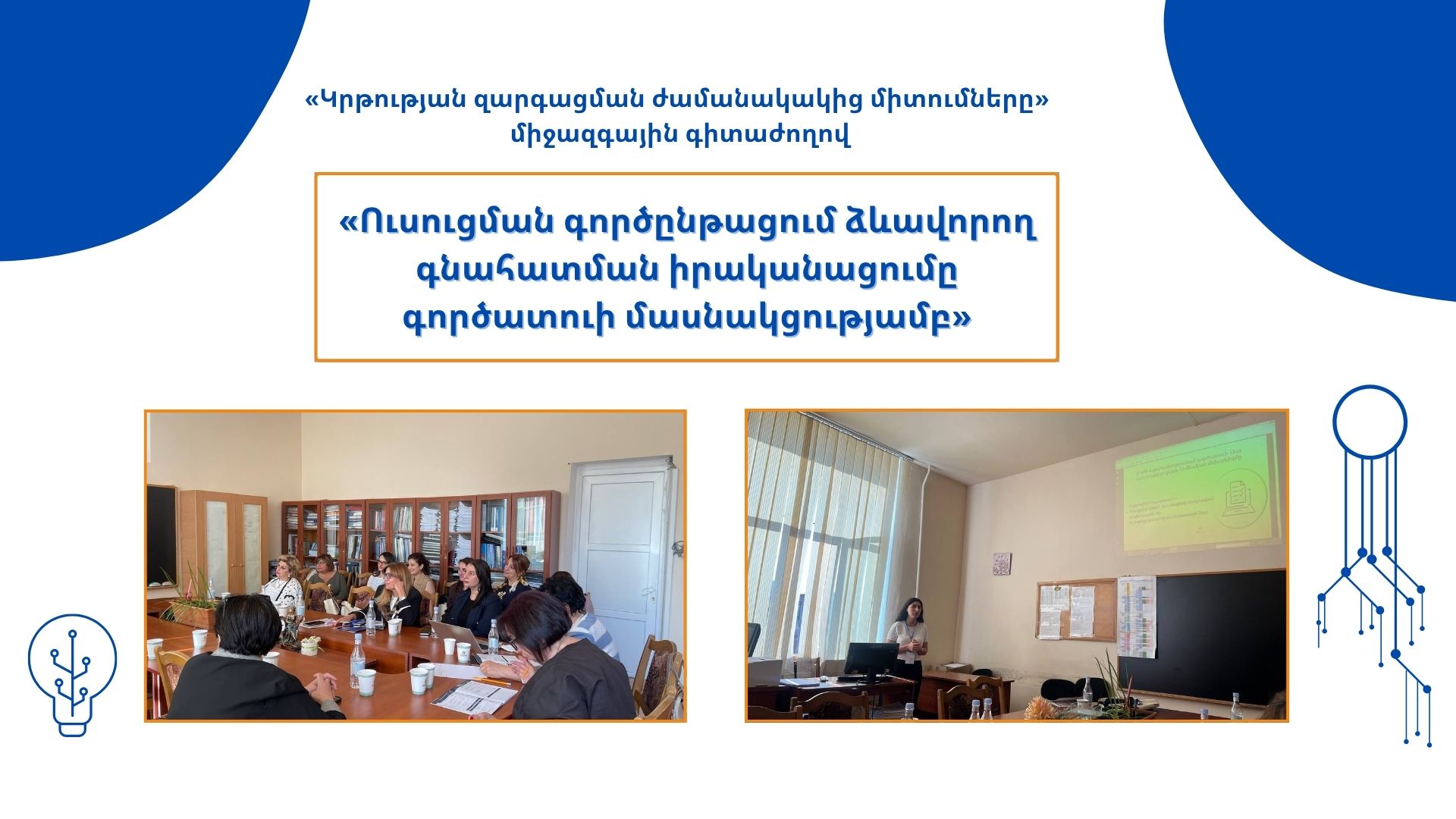
On September 25-26, the Bryusov State University held an international conference "Current trends in education development" with the participation of representatives from educational organisations of Armenia and abroad.
During the Pedagogy Session, Varduhi Gyulazyan, head of ANQA’s Institutional and Programme Accreditation Division, and Anahit Terteryan, specialist at the same division, delivered a presentation. The topic was "Formative assessment with the employer participation".
The presentation introduced ANQA’s model designed to ensure a close link between the educational process and the labour market. The model views employers as integral participants and active partners in teaching and assessment. Together with teachers, they create student assignments and set assessment criteria, allowing teachers to provide feedback that reflects the employer perspective.
Thus, the model implies:
- the joint development of assignments by teachers and employers aligned with real-world work situations;
- the observation of student performance in the classroom, laboratory, or simulated settings;
- the formative assessment guided by employer criteria;
- the use of employer-focused practical cases;
- the process of continuous enhancement, with students developing their skills and employers updating criteria.
The speakers outlined the current and proposed models of cooperation with employers, highlighting the key differences. Today the educational process is largely theory-based, with teacher-only feedback and minimal employer participation, mainly in internships. The new model involves employers not only in the programme design, but also in the assessment process, making them active participants.
The implementation of the model is expected to result in:
- the alignment of vocational education with labour market requirements;
- the workplace-oriented practical feedback for students;
- the new insights into workplace standards for teachers;
- the employers’ role as active partners in skills development.
- the preparation of alumni as career-ready professionals.
Thus, practice and research show that active collaboration between employers and education institutions, combined with active participation in the teaching process, significantly fosters the development of students' practical skills and increases alumni's professional employment rates.