
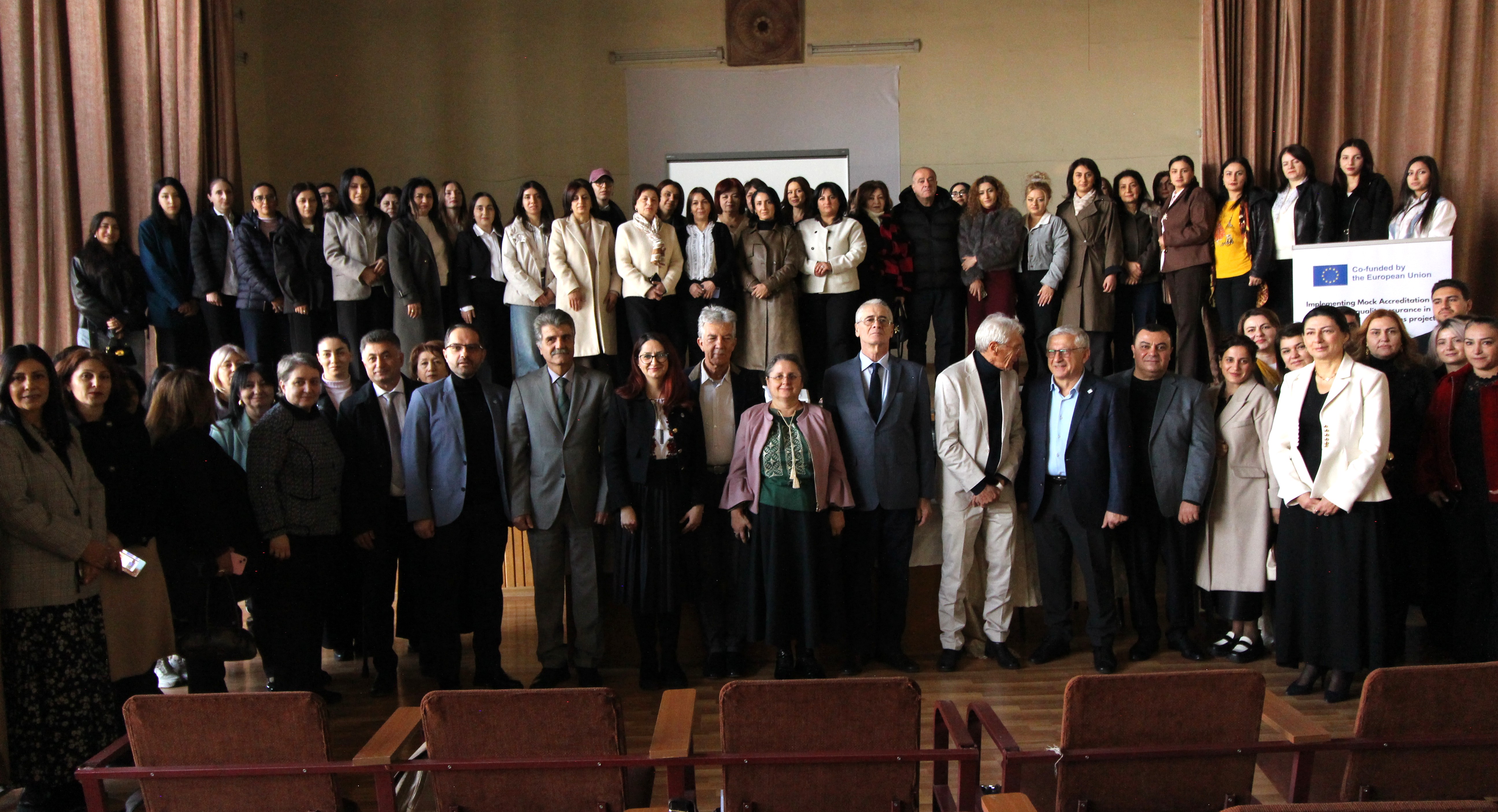
On November 12, the Yerevan Regional State College No. 2 named after N. Achemyan hosted the final dissemination conference of the Erasmus+ “Implementing mock accreditation for supporting quality assurance in Armenian VET institutions” project - QA4VET.
Ruben Topchyan, ANQA's director, delivered a welcoming speech, highlighting the significance of the QA4VET project in the development of VET institutions' internal quality assurance (IQA) capacities, the exchange of practice and a culture of continuous enhancement.
Ruben Topchyan then delivered a presentation “Quality assurance in Armenia’s VET system: reform agenda and key challenges”, outlining the developments in the VET QA system, the outcomes of accreditation processes and future priorities. During his presentation, Dr. Topchyan, emphasised the role of the first cycle of accreditation in the establishment of QA teams, the development of self-evaluation capacities and the systematisation of QA processes in VET institutions.
Regarding the further system development, several key priorities were identified:
- the expansion of programme accreditation, with a focus on in-depth evaluation of academic programmes (APs), the achievement of learning outcomes, the effectiveness of teaching and assessment methods and the development of students’ professional competencies;
- the AP revision and alignment with labour market requirements, with an importance placed on the periodic programme evaluation, the identification of issues in professional sectors and the observation of opportunities for cluster accreditation.
- the enhancement of governance effectiveness, with an emphasis on evidence-based decision-making, the professional development of teaching staff and the evaluation of institutional performance.
- the strengthening of IQA systems, highlighting the importance of the institutions’ competencies to independently identify issues, implement enhancements and evaluate their effectiveness.
- the enhancement of the effectiveness of practical teaching and dual education, with a focus on students’ professional preparedness and quality assurance of workplace-based learning.
- the development of international cooperation, attaching importance to the study of European practices and the application of the international project outcomes to strengthen the institutions' capacities.
Ruben Topchyan highlighted the application of mock accreditation not only as a preparation for accreditation but also as an independent IQA tool, enabling institutions to evaluate APs and specific processes, identify enhancement areas and monitor the effectiveness of implemented changes.
Another key aspect of ANQA’s contribution to the QA4VET project was the presentation of the Mock Accreditation Manual (MAM) developed as part of the project and the prospects for its continued application.
Anahit Terteryan, specialist at ANQA’s Institutional and Programme Accreditation Division, shared the MAM methodology, the outcomes of mock accreditation and opportunities for its future application. Ms. Terteryan emphasised the importance of the integration of mock accreditation as a tool for IQA, AP evaluation and continuous quality enhancement.
The conference also featured two panel discussions.
The first panel discussion “Institutional perspectives: impact of mock accreditation and guidance for sustainable use of the MAM”, brought together VET institutions' directors, QA specialists and internal experts. The discussion addressed the enhancements based on mock accreditation outcomes, the application of the practice gained to AP evaluation processes, the evaluation of the effectiveness of enhancements and opportunities for the independent and continuous use of the developed tools beyond the project completion.
Meri Barseghyan, specialist at ANQA’s Policy Development Division and coordinator of the "Students’ Voice" project, moderated the second panel discussion “Student voice in quality assurance and mock accreditation”. Participating students and graduates shared their experiences with mock accreditation, discussed priorities for the education quality enhancement and highlighted the importance of student engagement in decision-making processes. The discussion also highlighted the role of student feedback in the evaluation of the effectiveness of implemented enhancements.
The key message of the discussions was that the tangible impact of mock accreditation should be demonstrated through enhancements in institutional performance, APs and the quality of students’ learning experiences.
The QA4VET project’s final dissemination conference offered an opportunity to introduce the project achievements, exchange international and local practices, outlining future directions for the application of mock accreditation as a tool for VET institutions' IQA and continuous quality enhancement.